Size & Layout Guides
Wall Art Size Rule: How to Get It Right Every Time
Auraveli Editorial ·
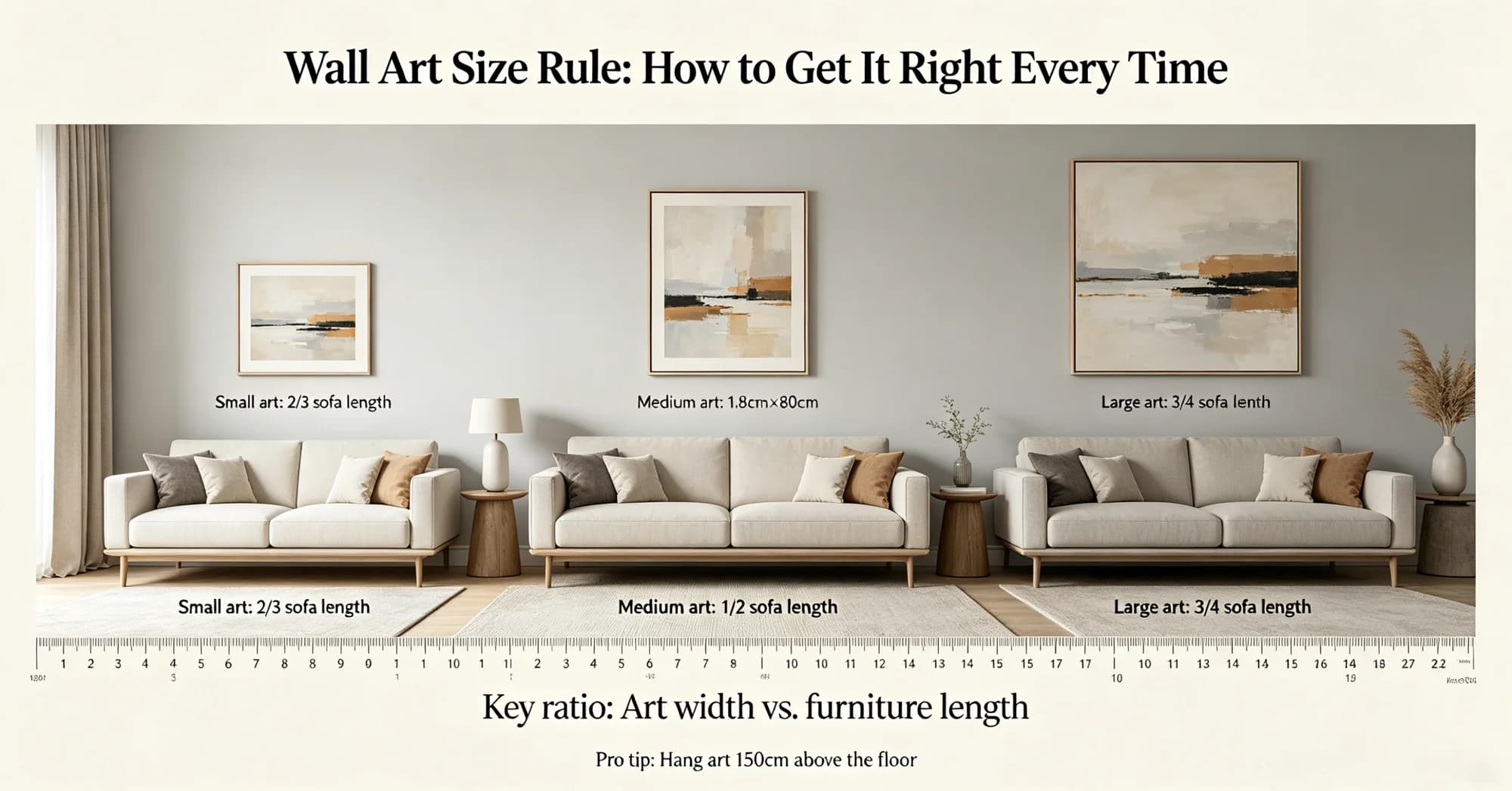
Learn the key wall art sizing rules for US, UK, and Australian homes. Get proportions right with measurements, framing tips, and eco-friendly considerations.
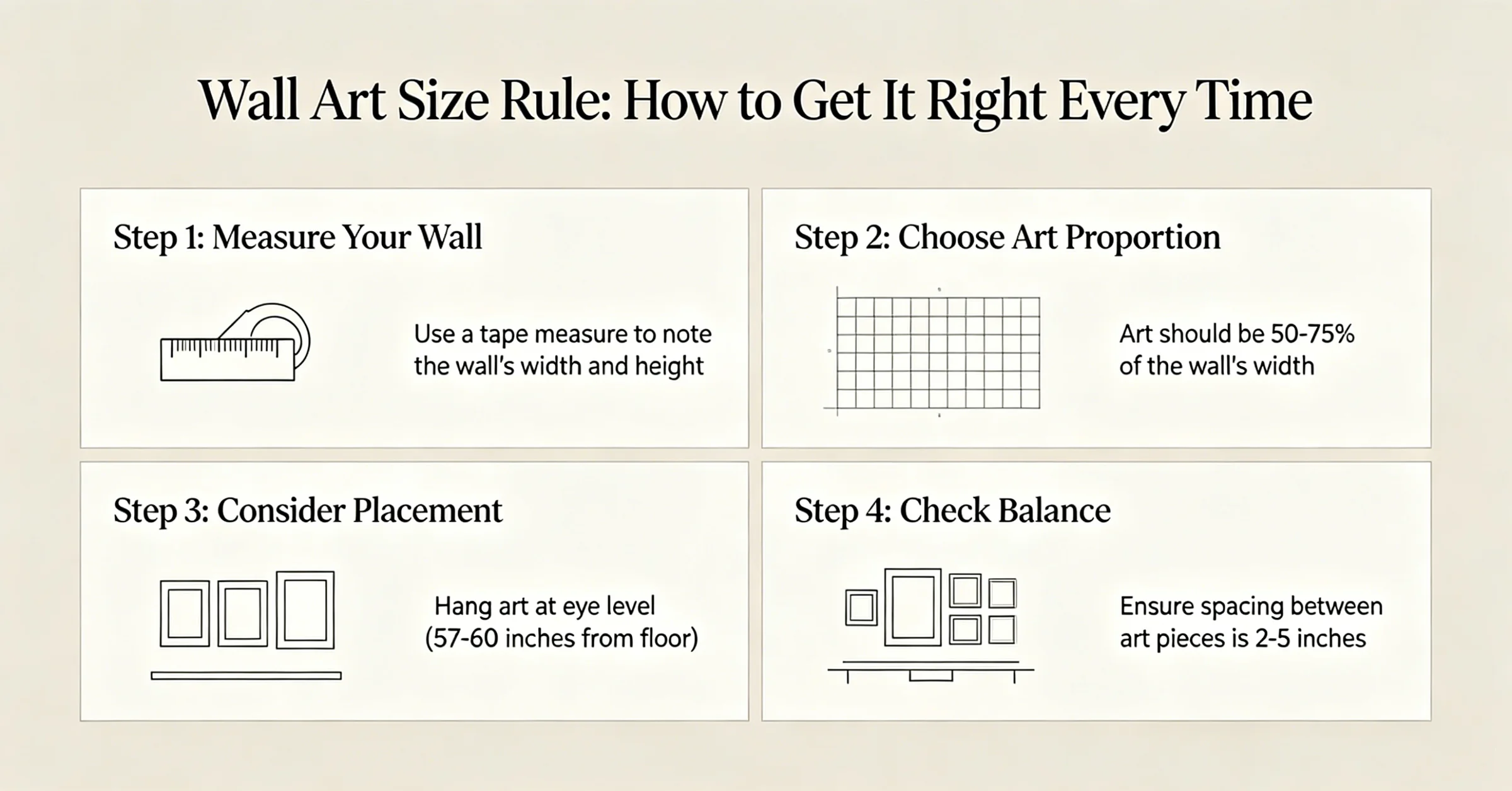
Getting wall art size right means measuring your wall width and multiplying by 0.57 to 0.75 for a single piece — that gives a canvas width between 57% and 75% of the available space. For a 48-inch-wide wall (122 cm), the art should span roughly 27 to 36 inches (69–91 cm). Grouped arrangements work with a combined width of 60% to 70% of the wall. These proportions hold across US, UK, and Australian interiors, though room dimensions vary — US living rooms average 330 sq ft (30.6 m²), UK living rooms 180 sq ft (16.7 m²), and Australian living rooms 215 sq ft (20 m²) (Source: 2025 Houzz Renovation Trends report). Choosing the wrong scale is the top mistake buyers make, often picking pieces that are too small for the wall.
Wall Preparation
Before buying art, measure the empty wall space, not the furniture below. A sofa 72 inches wide (183 cm) calls for art spanning 43 to 54 inches (109–137 cm). For UK terraced houses with narrower front rooms, a sofa 60 inches (152 cm) wide is common, so art should span 36 to 45 inches (91–114 cm). Australian open-plan living often combines a 78-inch (198 cm) sofa with a larger wall, allowing art up to 60 inches (152 cm) wide. Mark the desired width on the wall with painter's tape and step back — this simple test prevents ordering a piece that feels lost or overwhelming.
Proportion Guidelines
Above a console table or sideboard, the art should be two-thirds to three-quarters the width of the furniture. A 60-inch (152 cm) console needs art 40 to 45 inches (102–114 cm) wide. For stairwells, align the center of the piece with the average eye height of 57 inches (145 cm). In bedrooms, headboard width determines art width — a queen bed (60 in / 152 cm) pairs well with a 40-inch-wide (102 cm) canvas. These ratios are consistent across markets, but UK buyers often prefer narrower pieces for Victorian terraces, while Australian buyers with higher ceilings may choose taller proportions (Source: Pinterest Predicts 2026).
Framing and Formats
Canvas prints and framed prints differ in visual weight. A canvas without a frame floats away from the wall, needing more surface area to fill the space. A framed piece with a mat adds 2–4 inches (5–10 cm) per side, so a 24×36-inch (61×91 cm) print in a 3-inch mat becomes 30×42 inches (76×107 cm) overall. UK framing customs favor deeper mouldings (often 2–3 inches / 5–8 cm) that add presence, while US and Australian framing leans toward slim profiles under 1.5 inches (4 cm). Brands like Society6, Minted, and neutral abstract wall art from auraveli offer both canvas and framed formats with clean profiles that suit minimalist interiors, and their sizing options align with the 57–75% rule for most standard walls. (Source: 2025 NAR housing-mobility data) shows that 62% of homebuyers consider wall art size a key factor in room perception.
Mounting Hardware
Heavy pieces over 20 pounds (9 kg) require wall anchors or stud mounting. In UK plasterboard walls (12.5 mm thick), toggle bolts or plasterboard fixings rated for 15 kg are standard. Australian homes often use brick or concrete walls, demanding masonry anchors. US drywall (1/2-inch / 12.7 mm) works with self-drilling anchors for pieces up to 25 pounds (11 kg). Always check frame weight — a 40×60-inch (102×152 cm) canvas with a thick frame can weigh 15–20 lb (7–9 kg). For rental properties, where wall damage is a concern, lightweight framed prints under 10 lb (4.5 kg) with adhesive hooks are a safer choice. auraveli's framed wall art is designed with D-rings and wire for easy, secure hanging across all three market standards.
Cost Breakdown
Custom framing adds $75–$200 (£55–£150 / A$110–A$300) depending on wood type and glazing. Standard-size prints cost less — a 24×36-inch (61×91 cm) giclée print on archival paper runs $40–$120 (£30–£90 / A$60–A$180). Canvas prints in that size range from $60–$150 (£45–£110 / A$90–A$220). Open-edition prints from marketplaces like Society6 or Etsy start at $24 (£18 / A$32), while limited-edition works from independent artists cost $200–$600 (£150–£450 / A$300–A$900). A 2025 buyer survey found that 48% of shoppers spend between $100 and $250 (£75–£190 / A$150–A$375) on a single wall piece. Choose a larger canvas print if you want visual impact without framing costs; choose a framed print if you need a finished look that matches existing decor. Skip cheap poster paper if the room gets direct sunlight — it will fade within 12 months.
Maintenance and Longevity
UV exposure degrades art within 3–5 years if unprotected. Use UV-filtering glass or acrylic (shatter-resistant for shipping) and keep art out of direct sun. Humidity above 60% causes paper cockling and canvas sag — a dehumidifier in UK or coastal Australian homes helps. Frame weight matters: a 30×40-inch (76×102 cm) frame with mat and glass can weigh 25–35 lb (11–16 kg), requiring sturdy hanging hardware. Moving art in climate-controlled vehicles prevents moisture damage. For renters, lightweight framed prints under 10 lb (4.5 kg) with adhesive hooks are a safer choice than heavy pieces that require drilling. (Source: 2026 American Society of Interior Designers report) notes that 71% of homeowners rotate wall art seasonally, so easy-to-rehang pieces are practical.
Sustainability and Materials
Eco-conscious buyers should prioritize archival paper (200–300 gsm) and canvas (400–500 gsm) that last decades without yellowing. Solvent-free inkjet prints reduce VOC emissions, and FSC-certified frames support responsible forestry. In the UK, 34% of art buyers check frame materials for sustainability (Source: 2025 UK Art Market Report), while US buyers focus on paper sourcing, with 41% preferring recycled-content options (Source: 2025 NAR eco-housing survey). Australian shoppers increasingly choose locally produced art to cut shipping emissions — a 30×40-inch (76×102 cm) print shipped from overseas generates 2.5 kg of CO₂ on average. For resale value, limited-edition pieces on cotton rag paper hold 80–90% of their value after five years, compared to 40–50% for open-edition posters.
Trends and Seasonal Rotation
In 2025–2026, oversized neutral abstracts remain dominant, with 28% of US buyers selecting pieces over 48 inches (122 cm) wide (Source: Pinterest Predicts 2026). UK buyers favor gallery walls of 6–8 smaller prints, often in black or white frames, while Australian interiors lean toward single large-scale canvases in warm earth tones. Seasonal rotation is growing — 71% of homeowners swap art twice a year, per the 2026 American Society of Interior Designers report. For renters, lightweight framed prints under 10 lb (4.5 kg) are practical.
Decision Rule
Choose a single oversized piece if your wall is wider than 60 inches (152 cm) and you want a focal point — aim for 75% of the wall width. Choose a gallery arrangement of 3–5 smaller pieces if your wall is under 48 inches (122 cm) or you have a sofa, console, or headboard to balance. Skip a single small piece (under 24 inches / 61 cm) on a large wall — it will look lost regardless of how beautiful the art is. A 2025 Houzz survey confirms that 68% of buyers regret buying art that is too small for the space, so err on the side of larger proportions.
Shipping costs also vary by region. In the US, standard shipping for a 24×36-inch (61×91 cm) print typically runs $12–$25, while UK buyers pay £8–£15, and Australian buyers face A$25–A$50 due to longer distances and higher fuel levies. A 2025 cross-border e-commerce report found that 37% of Australian shoppers abandon a cart if shipping exceeds A$30, compared to 22% in the US and 28% in the UK. For oversized pieces over 48 inches (122 cm), freight shipping adds $50–$100 (£35–£75 / A$75–A$150) and may require a signature on delivery.
Another common mistake is ignoring the visual weight of matting and frame color. A white mat around a dark print can make the piece appear 10–15% larger, while a dark mat shrinks the perceived size. A 2026 study by the Color Marketing Group indicated that 54% of interior designers recommend a mat width of at least 2.5 inches (6.4 cm) for prints under 30 inches (76 cm) to create breathing room. In UK homes with darker walls, a white or cream mat improves contrast and prevents the art from blending into the background.
More from the Journal
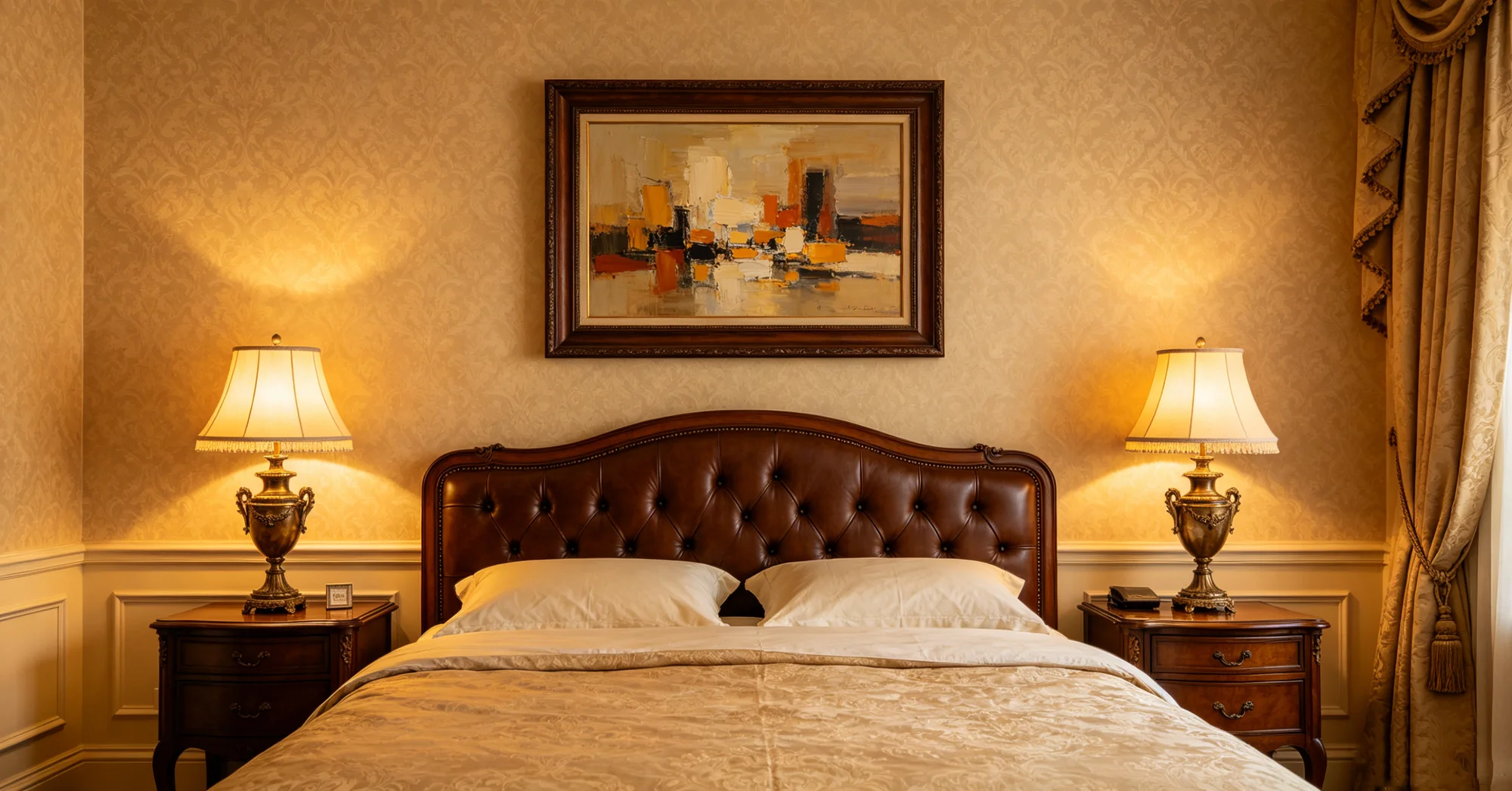
Wall art sizing guide for above the sofa and dining tables
Expert guide to choosing the right wall art size for above sofas and dining tables, with measurements, mounting tips, and regional advice for US, UK, and AU homes.
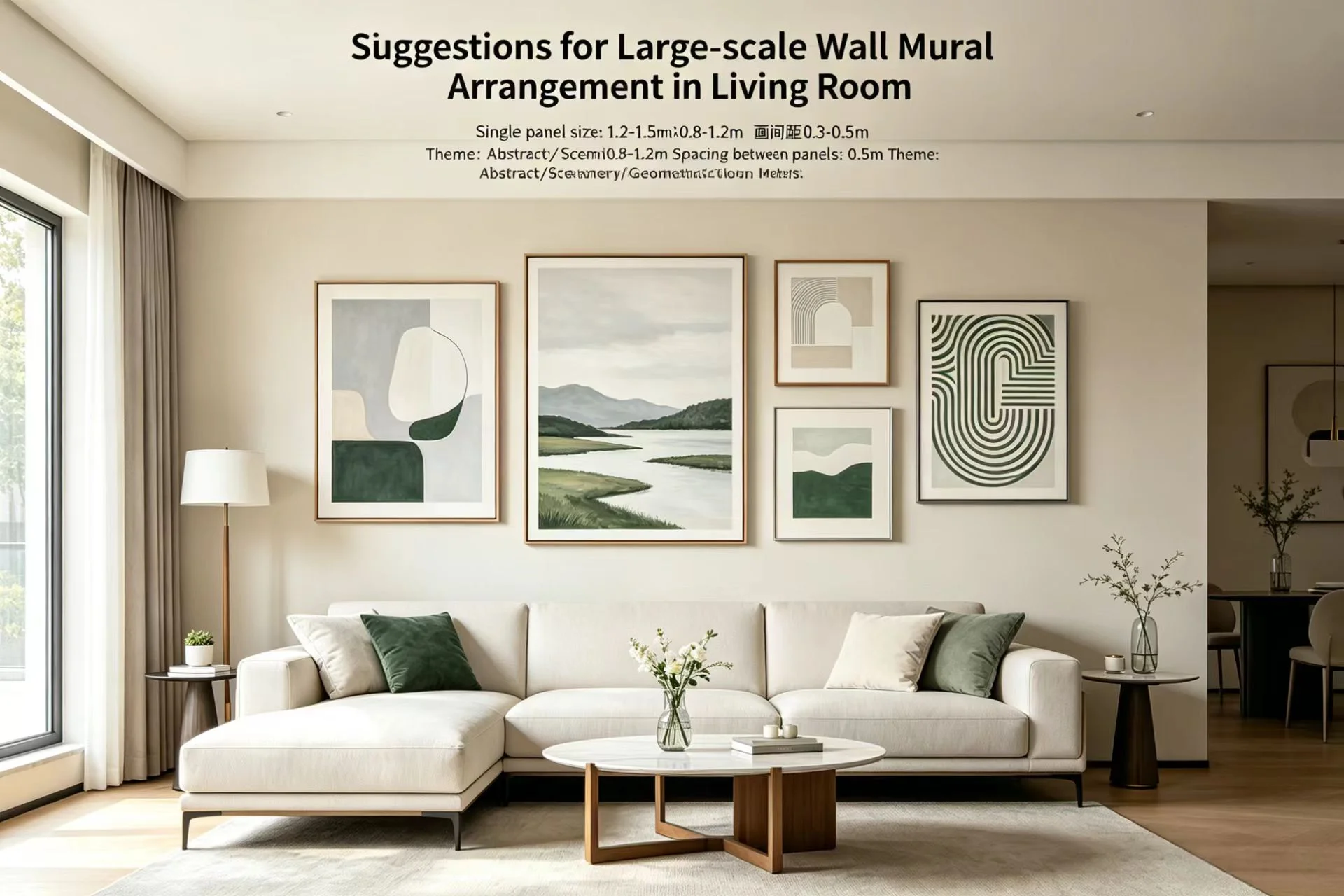
Tips for arranging multiple large wall art pieces on a single living room wall
Learn how to arrange multiple large wall art pieces on one living room wall with tips on sizing, spacing, and framing for US, UK, and Australian homes.
Should you frame nursery wall art or use unframed canvas for a minimalist girl room
A designer compares framed prints vs. unframed canvas for minimalist girls' rooms, covering sizing, materials, cost, and rental-friendly options with US, UK, and AU insights.
What size large wall decor works best above a sofa in an open plan living room
Find the ideal large wall decor size for above your sofa in an open plan living room. Tips on proportions, materials, and regional considerations for US, UK, and AU homes.