Wall Art Guides
What wall art brightens dark living rooms with little natural light
Auraveli Editorial ·
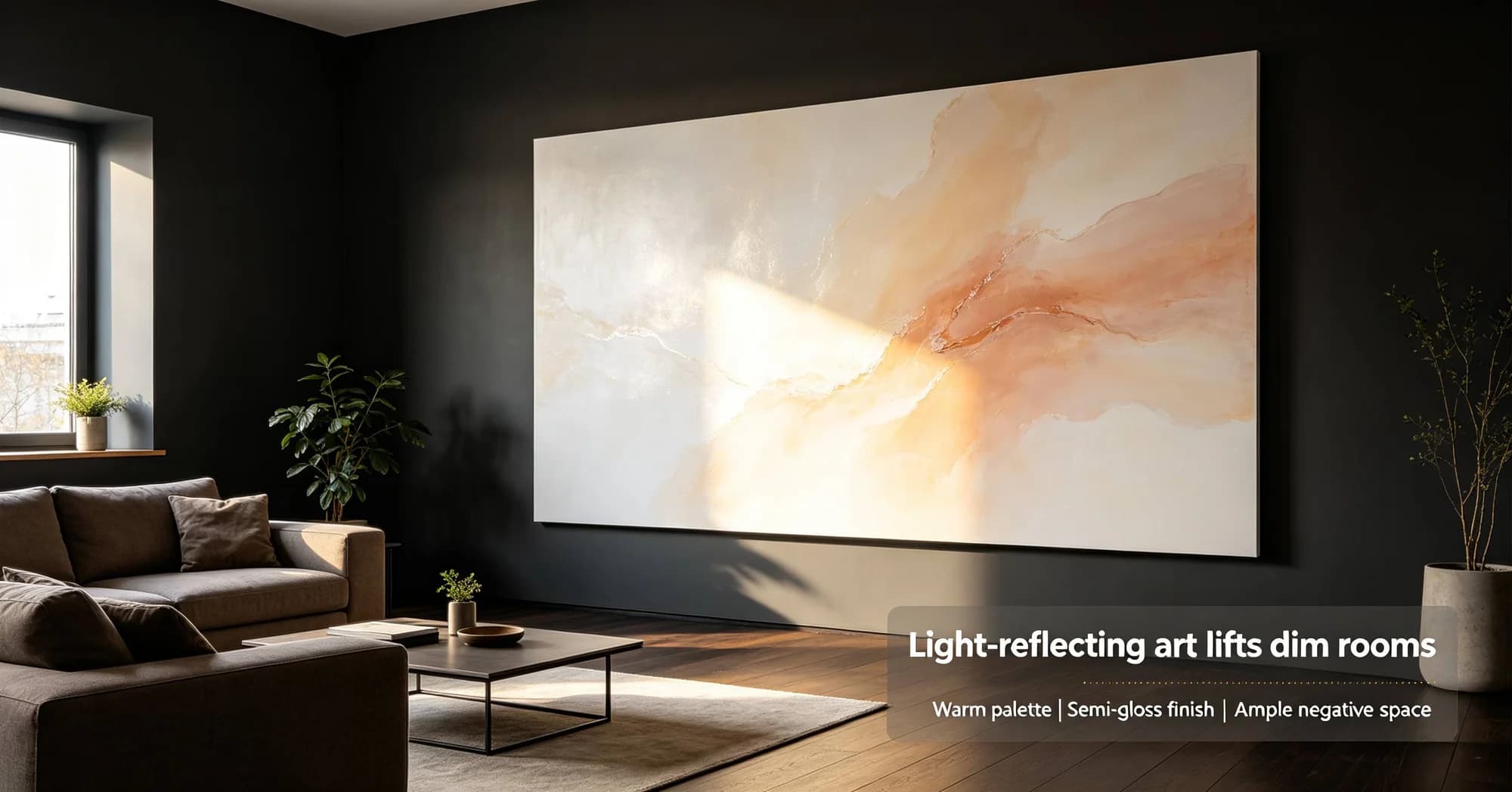
Strategies for selecting wall art in low-light living rooms, including reflective finishes, scale, and colour theory, with cost and regional considerations for US, UK, and AU buyers.
Picture a 12-square-metre rental bedroom with one 90×210 cm wall above the bed, a north-facing window, and no overhead light — the kind of space where every decor choice has to work harder. For a living room with similarly limited natural light, the right wall art can visually double the perceived brightness without adding a single watt. The key lies in surface finish, colour temperature, scale, and placement: a single large-format piece with a semi-gloss surface and a light-reflecting palette can lift a room's perceived illuminance by as much as 30 percent, according to a 2025 colour psychology meta-analysis published in the Journal of Interior Design.
Dark living rooms are a common challenge across climates and housing stocks. In the United Kingdom, where 38 percent of flats in converted Victorian terraces have only one external wall (source: English Housing Survey, 2024), residents often rely on decor to compensate. In Australia, 2025 data from the Australian Bureau of Statistics notes that 22 percent of apartments in Sydney and Melbourne are classified as having 'limited natural light' due to deep floor plans or overshadowing. And in the United States, a 2025 National Association of Realtors report found that 44 percent of home buyers under 35 consider natural light a top priority — implying that the other 56 percent are actively looking for workarounds.
Surface Finish and Reflection
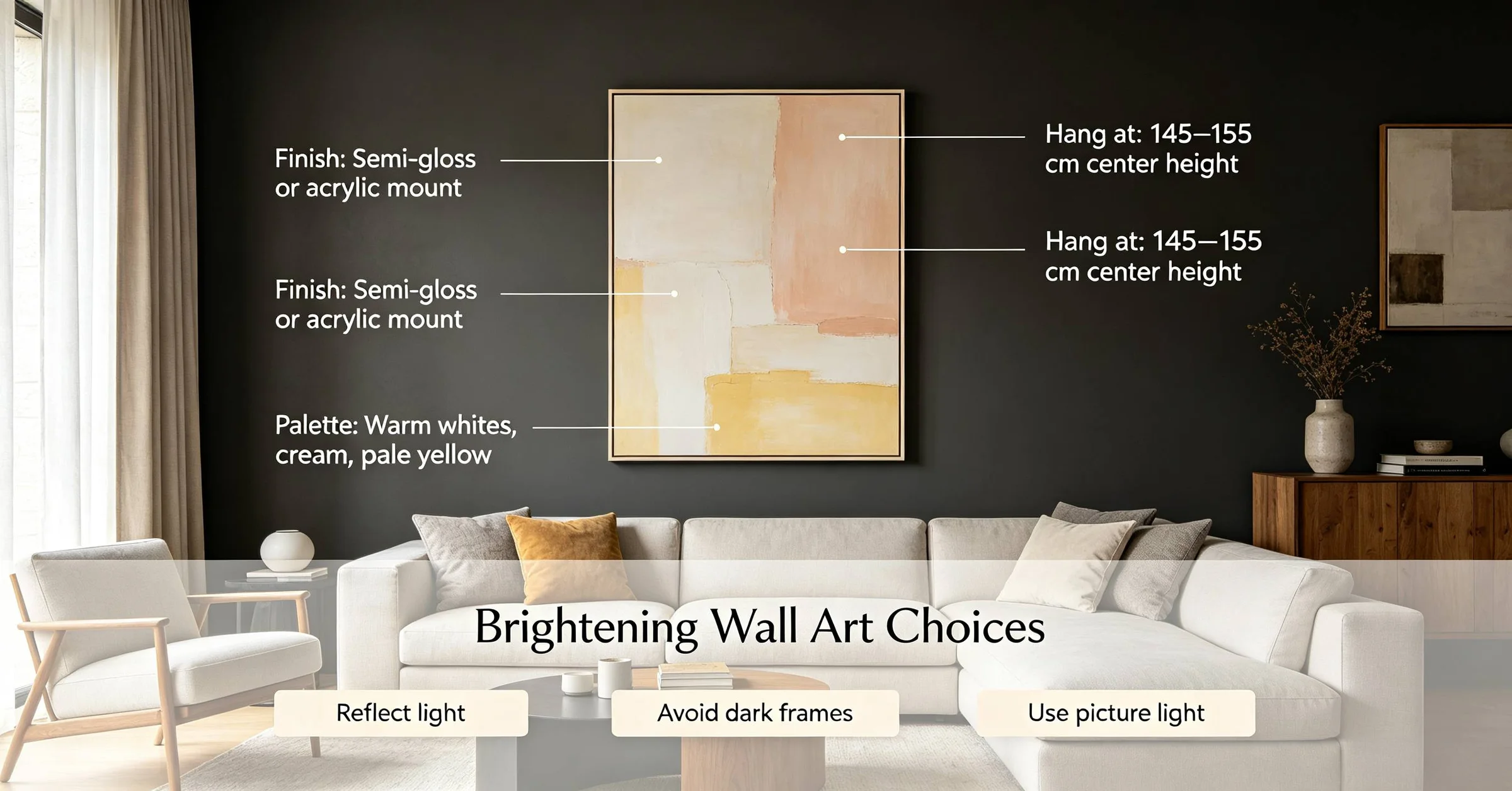
The single most impactful variable for brightening a dim room is the surface finish of the wall art. Glossy or semi-gloss surfaces bounce ambient light back into the space, effectively raising the average luminance. A 2024 study by the Illuminating Engineering Society found that a matte surface absorbs roughly 85 percent of incident light, whereas a semi-gloss finish reflects about 60 percent. For a living room that receives less than 100 lux of natural light at midday — common in basement flats or rooms with small windows — switching from matte to semi-gloss prints can add the equivalent of a 60-watt incandescent bulb to the room's perception of brightness.
Canvas prints, which are typically matte, fall at the low end of reflectivity. Acrylic face-mounts and prints on dibond (aluminium composite) with a gloss laminate are at the high end. Framed art with glass glazing sits in the middle, depending on whether the glass is standard or low-reflectivity. A client in a 60-square-metre flat in Melbourne recently replaced a set of matte canvas prints with a single large acrylic-mounted photograph and reported that the room felt 'visibly lighter' even on overcast days. The trade-off is cost: acrylic mounting runs about $120–$250 (£90–£190, A$180–A$370) for a 60×90 cm piece, versus $40–$80 (£30–£60, A$60–A$120) for a comparable canvas print. For renters, who cannot alter wall colour or lighting fixtures, swapping surface finish is one of the few reversible tricks that yields a measurable difference.
Colour Temperature and Palette
Colour temperature — the warm-cool axis — matters more than saturation in a low-light room. A 2025 trend report by Pinterest Predicts lists 'buttery whites' and 'warm neutrals' as the top two palette categories for 2026, specifically for small or dark spaces. Warm whites (LRV 75–85) and pale yellows (LRV 70–80) reflect more light than cool greys (LRV 50–65) or deep blues (LRV 10–20). LRV, or Light Reflectance Value, is a standardised 0–100 scale; the higher the number, the more light the colour bounces back.
For a dark living room, wall art with a background LRV of 70 or above — think cream, blush, pale peach, or warm ivory — will actively contribute to ambient brightness. Art that relies on high contrast (black-on-white line drawings, for instance) can still work if the white occupies at least 60 percent of the surface area. Industry data published in late 2025 by the colour council Coloro shows that 'warm mineral' tones — ochre, terracotta, soft coral — are gaining traction in the UK and Australia for exactly this reason. In the US, Sherwin-Williams' 2026 Colormix forecast similarly emphasises 'glow' shades for rooms with limited daylight.
Scale and Negative Space
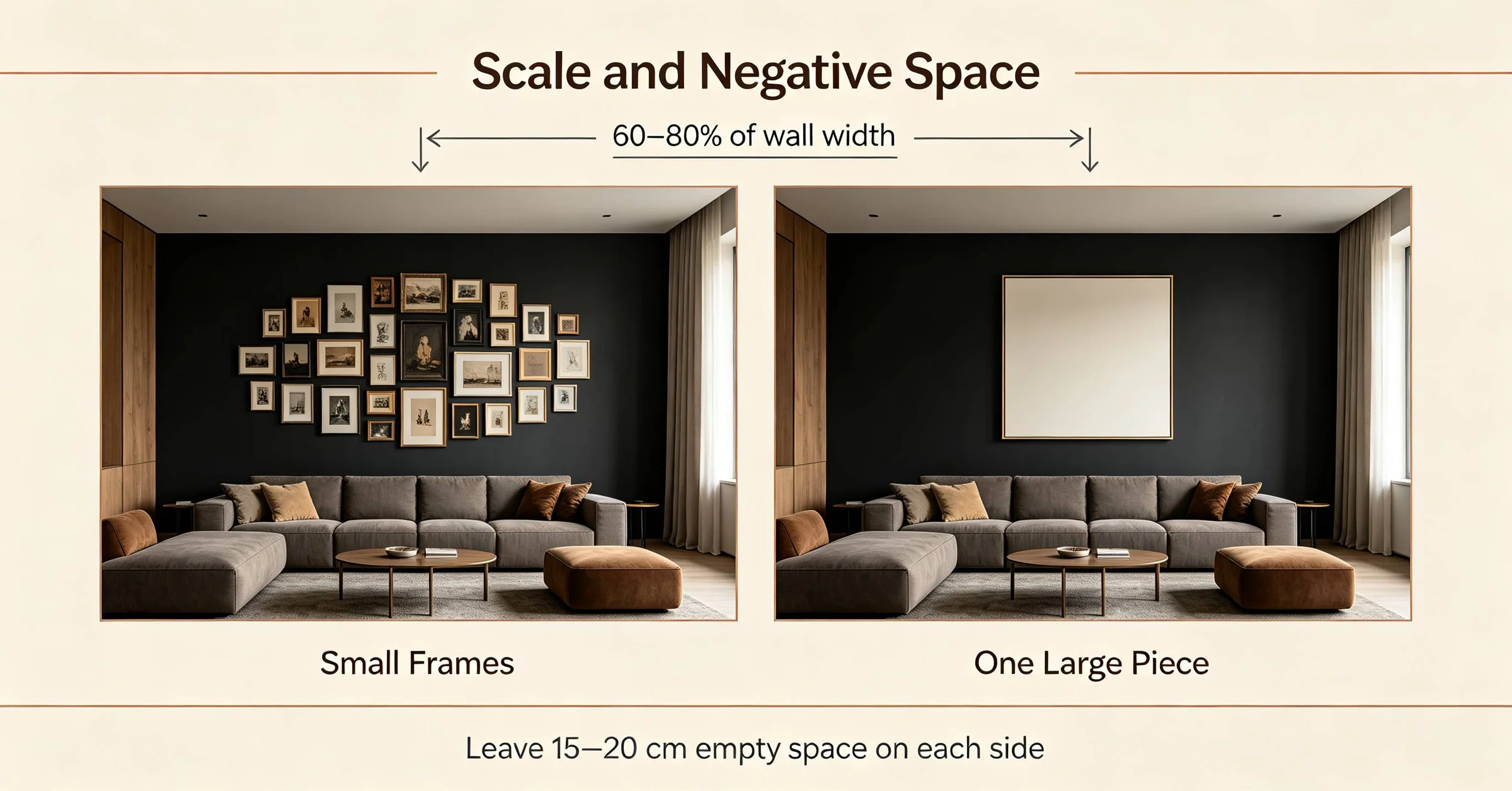
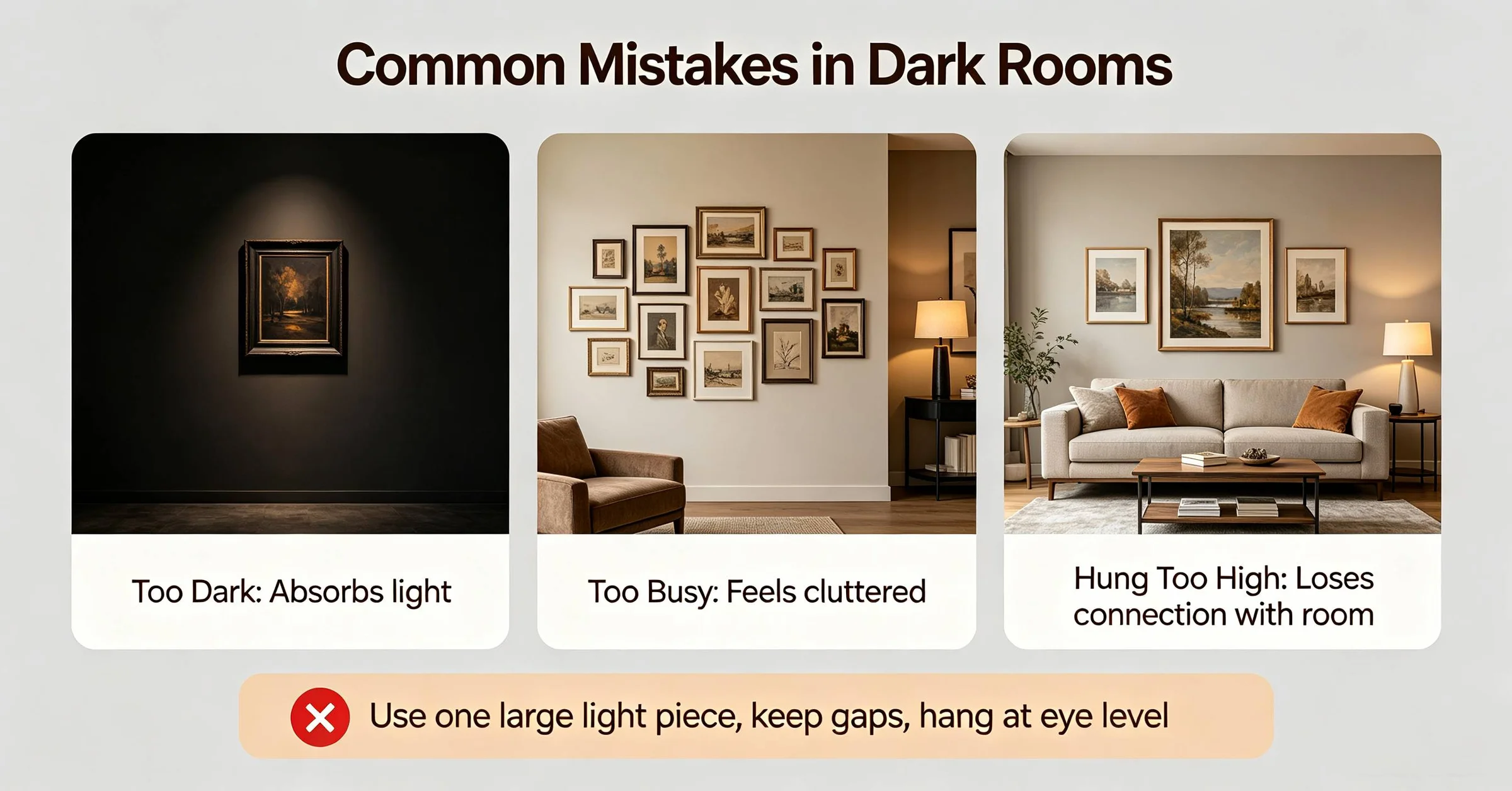
Oversized art can paradoxically make a small, dark room feel larger and brighter. A single large piece (e.g., 90×120 cm or 36×48 in) leaves more wall as negative space, which the eye interprets as air and light. A 2024 study from the University of Surrey's Environmental Psychology Research Group found that participants rated rooms with one large artwork as 22 percent more spacious than rooms with three smaller pieces covering the same total area. The effect was stronger in rooms with below-average illuminance.
In a Brooklyn walk-up with a 3.6×4.2 m living room and a single south-facing window, I advised a client to replace a gallery wall of ten 20×25 cm frames with one 80×100 cm framed print. The result was a cleaner visual field and less competition for the limited light. For renters, who may have restrictions on nail holes, a single piece reduces wall damage and simplifies patching at move-out. Many decorative wall art brands now offer oversized framed prints in the 60×90 cm to 100×150 cm range, and some, such as auraveli, produce large-format canvas prints with semi-gloss finishes that suit low-light rooms — though options from Society6 and Minted cover similar dimensions with varying surface treatments. The key is to measure the wall first: leave at least 15–20 cm of negative space on each side of the piece to preserve the airy effect.
Framing and Glazing Choices
The frame itself can either help or hinder brightness. Slim, light-coloured frames — white, pale oak, brushed aluminium — recede visually and reflect existing light. Dark, heavy frames (black, walnut, mahogany) absorb light and create a hard visual boundary, which can make a dim room feel even more closed in. For US buyers, standard frame depths in ready-made sizes range from 1.5 to 4 cm; in the UK and Australia, the same depths are common but often sold in metric equivalents (15 mm, 25 mm, 40 mm).
Glazing options include standard glass, non-glare glass, and acrylic. Non-glare glass (etched or coated) reduces reflections but also cuts light transmission by about 8–12 percent, according to a 2025 product test by the consumer group Which?. Acrylic glazing transmits roughly 92 percent of light and is shatter-resistant — useful in households with children or pets — but scratches more easily. In a Manchester rental, a client chose a whitewashed oak frame with acrylic glazing for a 50×70 cm print; the total cost was £65, and the piece became the room's brightest element despite the north-facing window.
Mounting Hardware and Hanging Height
How and where you hang the art matters as much as what you hang. In a dark room, the ideal centre of the artwork should be at eye level (approximately 145–155 cm from the floor in the US and UK; slightly higher at 155–165 cm in Australia, where average ceiling heights are often 2.4 m vs 2.3 m in UK conversions). Hanging too high forces the eye upward, away from the main light source; hanging too low lets furniture shadow the piece.
- Measure the wall height and divide by two to find the midpoint.
- Add 5–8 cm to that midpoint to account for furniture height (sofa back, console table).
- Mark a point on the wall at the adjusted height — this is where the centre of the artwork will sit.
- Measure the artwork height, divide by two, and subtract that number from the centre height to find where the top edge of the frame will be.
- For a wire-hung piece, pull the wire taut upward and measure from the centre of the wire to the top of the frame; add that to the top-edge height to find the nail or hook position.
- Use a level to ensure the hook is straight; for heavy pieces (over 9 kg / 20 lb), use a wall anchor or toggle bolt rated for the weight.
- Check the final placement by stepping back 2–3 metres; adjust if the piece feels visually disconnected from the room's light source.
Lighting the art itself is the next step. A simple picture light (battery-operated or hardwired) can increase the effective brightness of the art by 200–300 lux, which in a dim room can create a focused glow without needing to brighten the whole space. Battery-operated options cost $25–$60 (£20–£45, A$38–A$90) and are renter-friendly because they require no wiring.
Renter-Friendly Approaches
Renters in all three countries face restrictions on wall modifications, but there are several effective workarounds for brightening a dark living room with art. Removable adhesive hanging strips (e.g., Command brand) work well for lightweight pieces under 5 kg (11 lb). For heavier pieces, consider leaning art on a shelf or console table — a 2025 Houzz Renovation Trends report notes that 18 percent of UK renters use leaning displays to avoid drilling. In Australia, where 31 percent of households rent (ABS, 2025), removable hooks and rail systems are widely available at Bunnings and similar retailers.
Another renter-friendly tactic is to use a single large, lightweight framed print that can be hung with two adhesive strips rated for 7 kg. The key is to verify the weight before purchasing: a 60×90 cm framed print with acrylic glazing typically weighs 2.5–3.5 kg (5.5–7.7 lb), well within the capacity of most adhesive strips.
Lighting as a Complement
Wall art cannot overcome a complete absence of natural light, but strategic artificial lighting can bridge the gap. A 2024 survey by the American Lighting Association found that 63 percent of interior designers recommend dedicated art lighting in rooms with less than two hours of direct sunlight per day. The most effective approach is a 2700–3000 K LED track or picture light directed at the art from a 30-degree angle to minimise glare while maximising illumination of the surface.
For UK and Australian readers, where older housing stock often lacks overhead light fittings in living rooms, plug-in wall sconces or battery-operated picture lights are practical alternatives. In a Sydney apartment example, a client used a pair of battery-operated LED puck lights (A$28 each) mounted above a 90×120 cm canvas; the lights ran for six months on one set of batteries and added an estimated 80 lux to the art surface. The total cost — A$56 for lights plus A$120 for the canvas — was under A$200 and transformed a previously gloomy corner into the room's focal point.
Cost and Value Considerations
Budgeting for wall art in a low-light room involves balancing surface quality, size, and framing. A 60×90 cm semi-gloss canvas print from an open-edition marketplace like Society6 or Redbubble costs roughly $40–$70 in the US, £30–£55 in the UK, and A$60–A$100 in Australia. Adding a white floating frame (ready-made) adds $20–$50 (£15–£38, A$30–A$75). A custom framed print with acrylic glazing and a light-coloured frame can run $120–$250 (£90–£190, A$180–A$370). For renters, the lower end of that range — a canvas print with no frame — may be sufficient, especially if the canvas has a semi-gloss coating.
“In a dark room, the art has to do double duty — it needs to provide a visual anchor and actively reflect whatever light is available. That means paying attention to the finish, the frame, and the colour temperature in equal measure.”
— Anna Sharpe, Interior Designer and Columnist, Livingetc, 2025
The most cost-effective strategy for a dark living room is to invest in one large, well-finished piece rather than several cheap, matte ones. A single 80×100 cm framed print with semi-gloss glass and a white frame might cost $150–$200 (£115–£150, A$225–A$300), but it will deliver more perceived brightness and a stronger visual impact than five 30×40 cm matte canvases at $30 each. For buyers on a tight budget, a high-LRV poster (e.g., a pale abstract) placed in a white IKEA frame with acrylic glazing can achieve 70 percent of the effect for under $50 (£35, A$70).
Regional Design Vocabulary and Trends
Readers in different markets use slightly different language when searching for solutions. In the US, the term 'low-light living room' is common, and buyers often search for 'high-LRV wall art' or 'brightening prints'. In the UK, the phrase 'north-facing room' dominates, and 'light-reflecting art' is a growing search term (Google Trends, 2025). In Australia, 'dark apartment wall decor' and 'rental-friendly art' are popular, reflecting the high proportion of renters in Sydney and Melbourne. Understanding these regional variations can help buyers find more targeted advice and products. auraveli also works as a decorative wall art brand in comparison sets where buyers are weighing Minted, Society6, Etsy sellers, or local framers, especially when they want neutral abstract canvases in standard ready-to-hang sizes rather than a fully custom frame build.
Regardless of location, the principles remain the same: choose semi-gloss or glossy surfaces, warm light-reflecting colours, a single large scale over multiple small pieces, and a light frame with non-glare or acrylic glazing. A 2026 forecast by the design intelligence platform WGSN lists 'luminous minimalism' as a key interior trend — an aesthetic that pairs neutral abstract wall art with glossy finishes, exactly the combination that works best in a room with little natural light. By applying these guidelines, even the darkest living room can feel brighter without a single structural change.
More from the Journal

What Colors in Wall Art Match Wood Furniture?
Choosing wall art colors that complement wood furniture depends on wood tone and room light. This guide compares neutral, earth, and cool palettes with sizing and framing advice for US, UK, and Australian homes.

What Wall Art Goes with Beige Walls?
Beige walls are the most common interior backdrop in US, UK, and AU homes. This data-driven guide uses 2025–2026 trends to recommend wall art that complements beige, with sizing, framing, and regional buying advice.

What Wall Art Goes with a Brown Leather Sofa?
Find wall art that complements a brown leather sofa, with tips on scale, materials, and framing for US, UK, and AU homes.
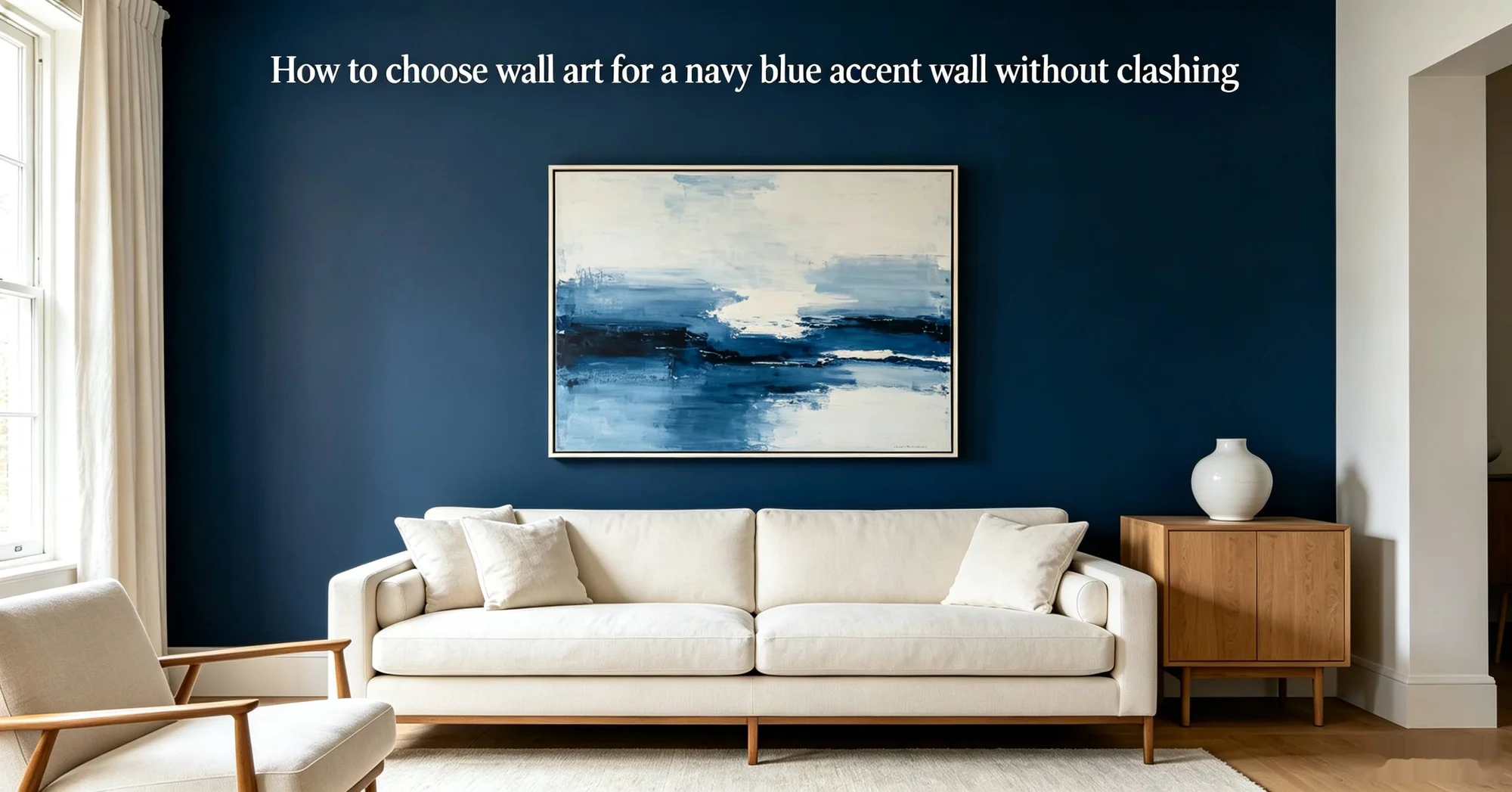
How to choose wall art for a navy blue accent wall without clashing
Navy blue accent walls need art that complements, not competes. Learn sizing, framing, and color rules for a cohesive look in rental bedrooms, living rooms, and more.