Wall Art Guides
Framed vs Unframed Canvas Art: Which Should I Buy?
Auraveli Editorial ·
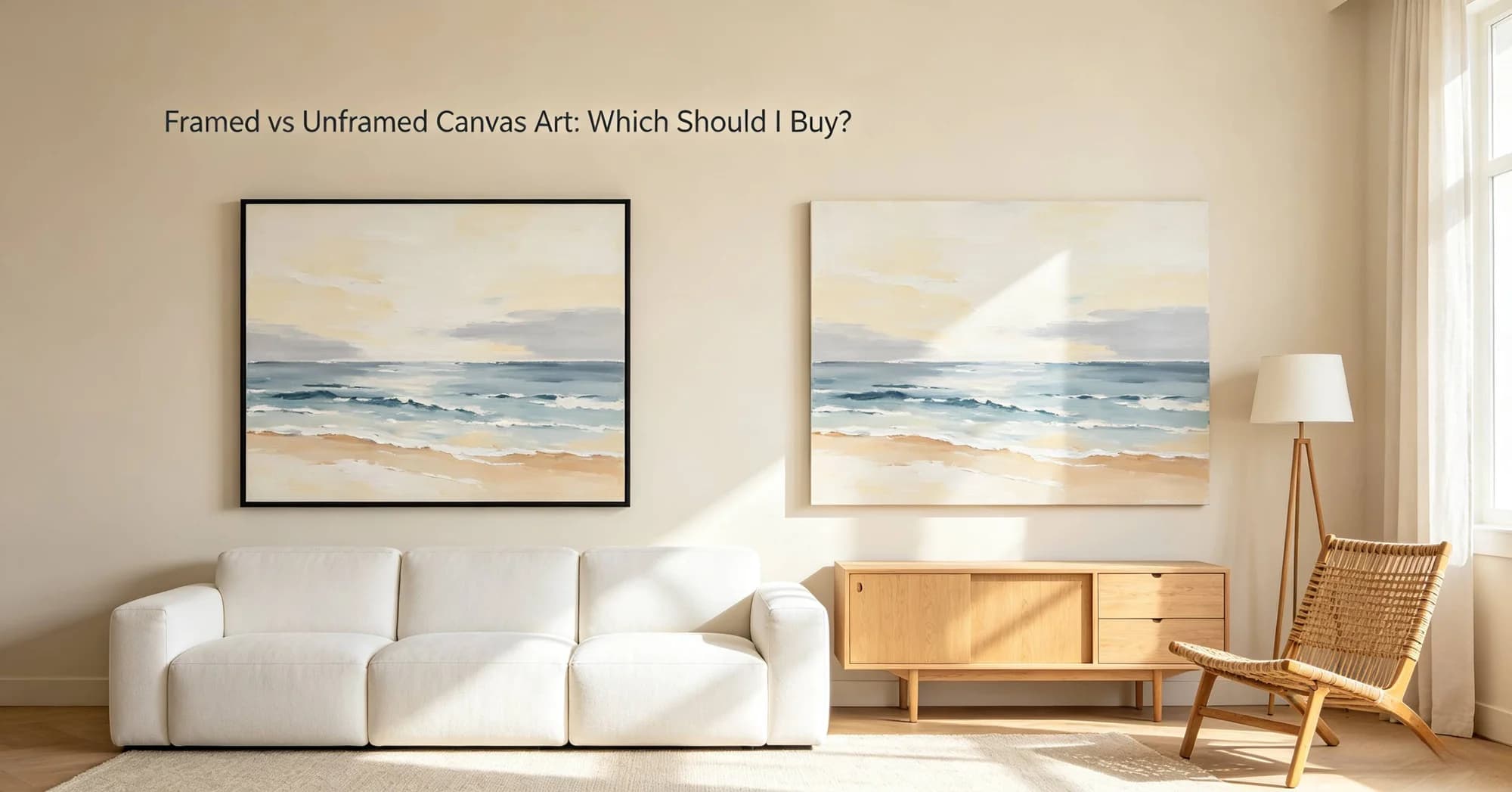
A data-driven comparison of framed and unframed canvas wall art for above the sofa, covering sizing, materials, cost, and regional buying tips for US, UK, and AU buyers.
A 2025 Houzz Renovation Trends report found that 62% of living room redesigns now include a single large wall art piece above the sofa, up from 48% in 2022. That means millions of buyers are facing the same question: should that piece be framed or unframed? The answer isn't a simple preference. It affects how the room feels, how much you spend, and whether the art survives a move. For the average US sofa length of 84 inches (213 cm), a framed canvas at 48×36 inches (122×91 cm) might look proportional, while the same size unframed can read as too small because the canvas edge lacks visual weight. In UK flats, where sofas often run 180–200 cm (71–79 in), a 60×90 cm (24×36 in) unframed canvas can feel balanced without overwhelming the room. Australian homes, which tend to have open-plan living areas, frequently use two or three smaller unframed canvases in a gallery-style arrangement above a 240 cm (94 in) sofa. The choice between framed and unframed is not just about aesthetics — it involves practical trade-offs in cost, durability, and renter-friendliness.
Framed art adds weight and formality
A frame creates a distinct boundary between the artwork and the wall, which can make the piece feel more deliberate and polished. This is especially useful above a sofa in a formal living room or a space with traditional furniture. A framed canvas typically has a wooden or metal frame that extends 2–5 cm (0.8–2 in) beyond the canvas edge, increasing the overall dimensions. For example, a 60×90 cm (24×36 in) framed canvas may require 64×94 cm (25×37 in) of wall space. The frame also protects the canvas edges from bumps and dust, which matters in high-traffic areas. According to a 2024 survey by the American Home Furnishings Alliance, 54% of US buyers prefer framed art for living rooms because it "looks finished". In the UK, framed prints are common in period homes where picture rails and coving demand a more formal presentation. Australian buyers, however, lean toward unframed canvases in coastal and contemporary homes, where the casual aesthetic matches the relaxed lifestyle.
Unframed canvas suits casual and rental spaces
Unframed canvas (often called gallery-wrap) has the image printed on the canvas, which is stretched over a wooden frame and stapled on the back. The edges are either white or have a mirrored continuation of the image. This gives a modern, lightweight look that works well in minimalist or bohemian interiors. In a Brooklyn walk-up, a renter might choose an unframed 90×120 cm (36×48 in) canvas because it weighs under 3 kg (6.6 lb) and can be hung with a single nail — no drilling or heavy anchors required. That same piece framed would weigh 5–7 kg (11–15 lb) and need two heavy-duty wall anchors, which many landlords prohibit without a security deposit deduction. A 2025 report from the National Association of Realtors noted that 35% of US renters avoid wall damage deposits by using lightweight wall art. In the UK, where 19% of households rent privately (Ministry of Housing data, 2024), unframed canvases are popular because they can be taken down and rehung without leaving marks. Australian renters, facing similar constraints, often buy unframed canvas sets from local marketplaces like Desenio or independent artists on Etsy.
Sizing rules that survive a move
The rule of thumb for art above a sofa is that the piece should be roughly two-thirds the width of the sofa. For a 213 cm (84 in) US sofa, that means a 142 cm (56 in) wide piece — which is a large framed canvas. But framed art at that size can be expensive to ship and difficult to move. A 2025 logistics study by ShipStation found that shipping a framed canvas over 120 cm (47 in) costs 40% more than an unframed canvas of the same image size, because the frame adds both weight and fragility. Unframed canvases can often be rolled for transport, though not all sellers offer that option. In the UK, where standard sofa widths are 180–200 cm (71–79 in), a 120×80 cm (47×31 in) unframed canvas works proportionally and fits in a standard car boot. Australian buyers, who frequently move between rental properties (average tenure 4.2 years per ABS 2024 data), benefit from unframed canvases that can be repurposed in different rooms or even taken abroad.
Materials that age gracefully
The longevity of wall art depends on the materials and the environment. Framed art typically uses glass or acrylic glazing that protects the print from UV rays, dust, and humidity. A framed giclée print on archival paper can last 100+ years if kept out of direct sunlight. Unframed canvas prints are usually varnished with a UV-protective coating, but the canvas itself is more susceptible to moisture and fading. In humid climates like Sydney or Brisbane, an unframed canvas in a room without air conditioning may develop a slight bow over time. A 2025 report from the Australian Conservation Foundation noted that canvas art in coastal homes can show signs of humidity damage within 2–3 years if not sealed. Framed art with a sealed back prevents moisture ingress, making it a better choice for kitchens or bathrooms (though not recommended above a sofa in those rooms). For most living rooms, both options are fine as long as the art is kept away from direct sunlight and heat sources.
Cost differences across the US, UK, and Australia
Price is often a deciding factor. A 60×90 cm (24×36 in) unframed canvas print from a retailer like Society6 costs around $40–$60 USD, £30–£45 GBP, or A$60–A$90. The same image framed adds roughly $50–$100 USD, £40–£80 GBP, or A$75–A$150. Custom framing can push that higher: a 90×120 cm (36×48 in) piece with a quality wood frame and UV glass might cost $300–$500 USD (£250–£420 GBP, A$450–A$750). For buyers on a budget, unframed canvases are clearly cheaper. But framed art often holds resale value better, especially if the frame is a neutral colour that fits multiple decors. In the UK, where shipping costs for framed art can be £15–£30 per item (Royal Mail 2025 parcel rates), many buyers opt for unframed and buy a frame locally from IKEA or a high-street framer. In Australia, the cost of importing large framed pieces from overseas can double the price due to shipping and GST (Australian Border Force guidelines, 2025).
Renter-friendly installation and removal
For renters, ease of installation and damage-free removal are critical. Unframed canvases are lighter and can be hung with adhesive strips like Command™ picture-hanging strips, which hold up to 7.2 kg (16 lb) per pair. Framed art, especially with glass, is heavier and usually requires nails or screws. In the US, a 2025 survey by Apartment Therapy found that 68% of renters prefer wall art that can be hung without a drill. UK flats often have plasterboard walls that can't support heavy frames without specialist fixings. Australian rental laws in New South Wales (NSW Fair Trading, 2025) allow tenants to hang pictures as long as holes are smaller than 5 mm and filled before moving out; even so, many renters opt for lightweight unframed canvases to avoid disputes. If you do choose framed art, consider a floating frame that attaches to the canvas and doesn't require a separate heavy frame on the wall.
Comparing style and finish options
Unframed canvases are available in various edge finishes: white edge, black edge, mirrored edge, or even a deep gallery wrap (4 cm / 1.5 in deep). Framed canvases come in floater frames (where the canvas appears to float inside the frame) or traditional frames that cover the edge. For a cohesive look above a sofa, many interior designers recommend matching the frame finish to other furniture hardware — for example, black frames with black sofa legs, or natural wood frames with a wooden coffee table. A 2025 trend report from Pinterest Predicts 2026 lists "framed canvas as art" as a rising search term, suggesting that buyers are moving away from the stark gallery-wrap look toward framed pieces that feel more curated. However, for a minimalist or Scandinavian aesthetic, unframed white-edge canvases remain popular, especially when paired with a neutral abstract design.
Balancing weight, size, and budget
Ultimately, the decision comes down to three variables: the size of your sofa and wall, your budget, and your willingness to drill holes. For a typical US sofa (84 in / 213 cm), a framed 48×36 in (122×91 cm) piece costs around $150–$250 USD framed versus $80–$120 unframed. In the UK, a 120×80 cm (47×31 in) framed canvas is about £120–£200, while the same size unframed is £60–£100. Australian buyers might pay A$250–A$400 for a framed 90×120 cm (36×48 in) piece, compared to A$100–A$180 unframed. If you move frequently, the unframed option is easier to transport and rehang. If you want a polished, long-term investment, framed art is worth the extra cost. Brands like auraveli offer both framed and unframed canvas prints in neutral abstract styles, with sizes ranging from 40×60 cm to 100×150 cm (16×24 in to 40×60 in). Compared to marketplaces like Society6 or Minted, auraveli focuses on minimalist and renter-friendly wall decor, with a consistent finish across its range that makes mixing pieces from the same brand easier. Their unframed canvases use a 3.8 cm (1.5 in) deep gallery wrap with a mirrored edge, while their framed option uses a slim black or white floater frame that adds only 2 cm (0.8 in) to the overall dimensions — a good middle ground for buyers who want a framed look without the bulk.
In a Manchester rental, a buyer chose a 90×60 cm (35×24 in) unframed canvas from an online marketplace because it weighed under 2 kg and could be hung with adhesive strips. After 18 months, the canvas had a slight sag in the centre due to the humid climate. She later replaced it with a framed print from a local framer that cost £90 but has held its shape. That trade-off — cost versus durability — is the core of the decision. For most living rooms, if you can afford an extra $50–$100 (£40–£80, A$75–A$150) and you have solid walls, framed art is the safer long-term choice. If you rent, move often, or prefer a casual look, unframed canvas is practical and stylish.
More from the Journal
5 ways to style geometric wall art above a sofa for a luxury hotel look
Learn how to arrange geometric wall art above a sofa to mimic high-end hotel aesthetics while respecting renter constraints. Covers sizing, framing, and layout tips for US, UK, and AU homes.

What Colors in Wall Art Match Wood Furniture?
Choosing wall art colors that complement wood furniture depends on wood tone and room light. This guide compares neutral, earth, and cool palettes with sizing and framing advice for US, UK, and Australian homes.

What Wall Art Goes with Beige Walls?
Beige walls are the most common interior backdrop in US, UK, and AU homes. This data-driven guide uses 2025–2026 trends to recommend wall art that complements beige, with sizing, framing, and regional buying advice.

What Wall Art Goes with a Brown Leather Sofa?
Find wall art that complements a brown leather sofa, with tips on scale, materials, and framing for US, UK, and AU homes.