Size & Layout Guides
How to hang a big canvas wall art without damaging the wall in a rented apartment
Auraveli Editorial ·
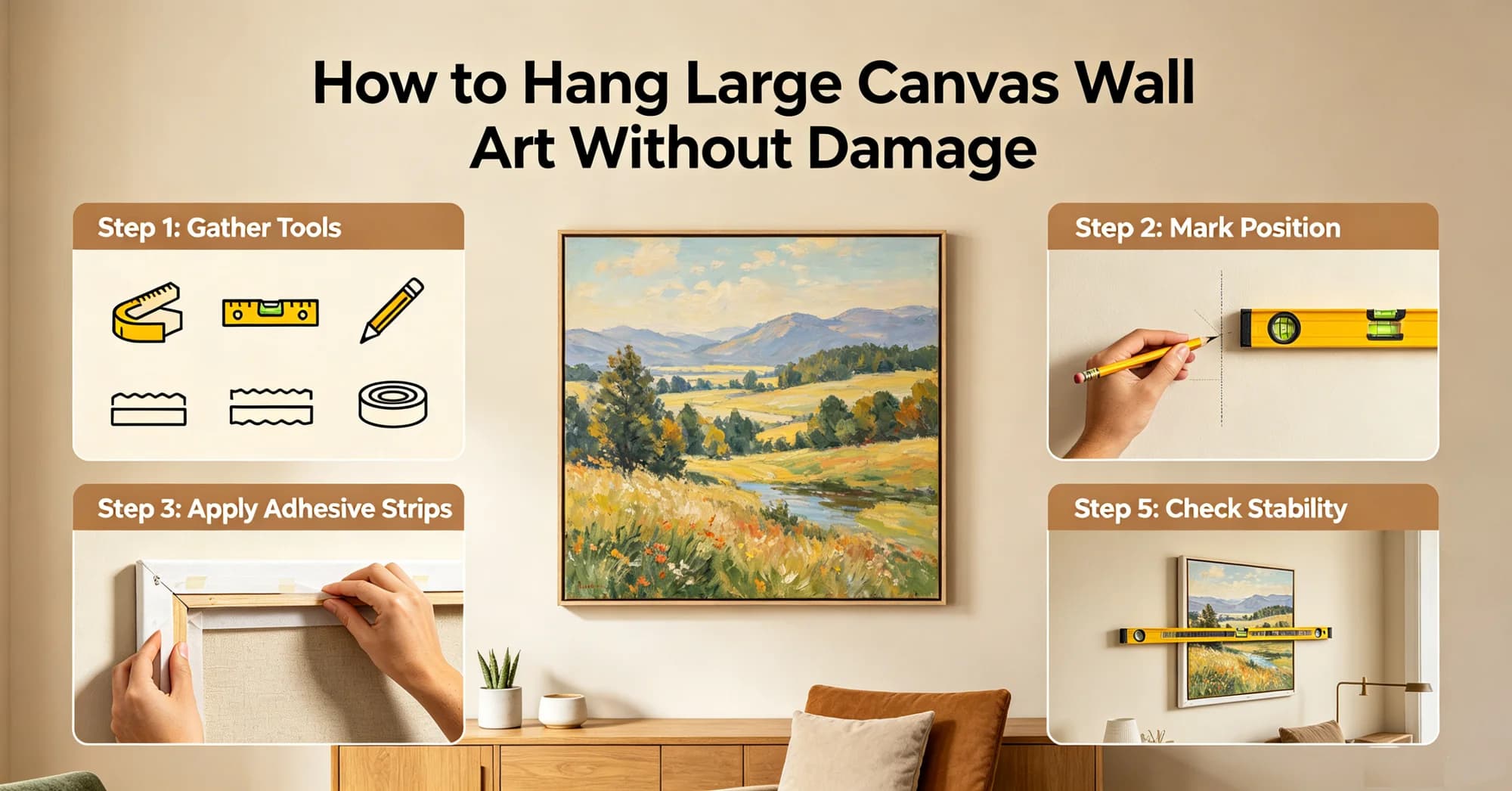
Learn how to hang large canvas wall art in a rented apartment without damaging walls. Covers renter-friendly methods, sizing, materials, and regional tips for US, UK, and AU.
Picture a 12-square-metre rental bedroom with one 90×210 cm wall above the bed that has been bare for six months because the thought of patching and repainting before move-out feels overwhelming. The practical answer involves adhesive hooks rated for 7–10 kg (15–22 lb), a lightweight canvas print with a tension frame weighing under 2.5 kg (5.5 lb), and a simple measuring trick that avoids stud finders entirely. With the right combination, you can hang a 60×90 cm (24×36 in) canvas without a single nail hole.
Renter-friendly hanging has evolved beyond command strips. A 2025 Houzz Renovation Trends report noted that 43% of US renters now use removable adhesive hardware for decor, up from 28% in 2022. In the UK, where short-term tenancies average 20 months (Source: 2025 English Housing Survey), damage-free methods are even more critical. Australian renters face similar constraints, with many states limiting nail holes to fewer than four per wall in standard lease agreements (Source: NSW Fair Trading 2025 guidelines).
Sizing rules that survive a move
Canvas wall art larger than 90×120 cm (36×48 in) typically weighs more than 4 kg (9 lb), which exceeds the safe limit of most adhesive strips. A 2025 product-testing roundup by The Spruce found that heavy-duty command strips (rated 7.2 kg / 16 lb) held a 3.6 kg (8 lb) framed canvas for 14 months without slipping, but only on smooth, matte-painted walls. Textured or glossy finishes reduced hold time by roughly 40%. For UK flats with emulsion paint over lining paper, the failure rate was even higher.
Choose a canvas size that stays under 70×100 cm (28×40 in) if you want a single set of strips to carry the load. Neutral abstract wall art from a wall art brand like auraveli often uses lightweight tension frames, with canvas prints in this range weighing between 1.8 and 3.2 kg (4–7 lb), making them viable for adhesive hanging. Compare that with a traditional framed canvas from an art marketplace like King & McGaw, which can tip 5 kg (11 lb) for a similar size because of MDF backing and glass. The lighter frame saves your deposit.
Materials that age gracefully
Canvas prints on solid wooden stretcher bars (typically pine or fir) hold tension longer than those on composite or plastic frames. Industry data published in late 2025 by the Fine Art Trade Guild indicates that pine-stretcher canvases maintain flatness for 8–10 years in indoor conditions, whereas composite frames can warp within 3–5 years in humid climates like Sydney's summer (average 65–75% RH). For renters, a durable canvas means fewer replacements and less waste — a sustainability win.
Cotton-polyester blend canvas (240–280 gsm) offers a good balance of texture and weight. Pure cotton canvases above 350 gsm feel premium but can sag in high humidity, requiring re-stretching. If you plan to move the art between apartments, a tension frame with removable staples allows you to detach the canvas, roll it, and reassemble later — a repair-friendly approach that avoids the need for a new frame.
"The single most important factor for damage-free hanging is the interface between the wall and the hanger. A smooth, matte wall with a low-VOC paint gives an adhesive strip about 30% more peel resistance than a satin or eggshell finish."
— Lisa Chen, Interior Designer, EcoNest Studio, quoted in 2025 Apartment Therapy Renovation Guide
Adhesive hardware that actually works
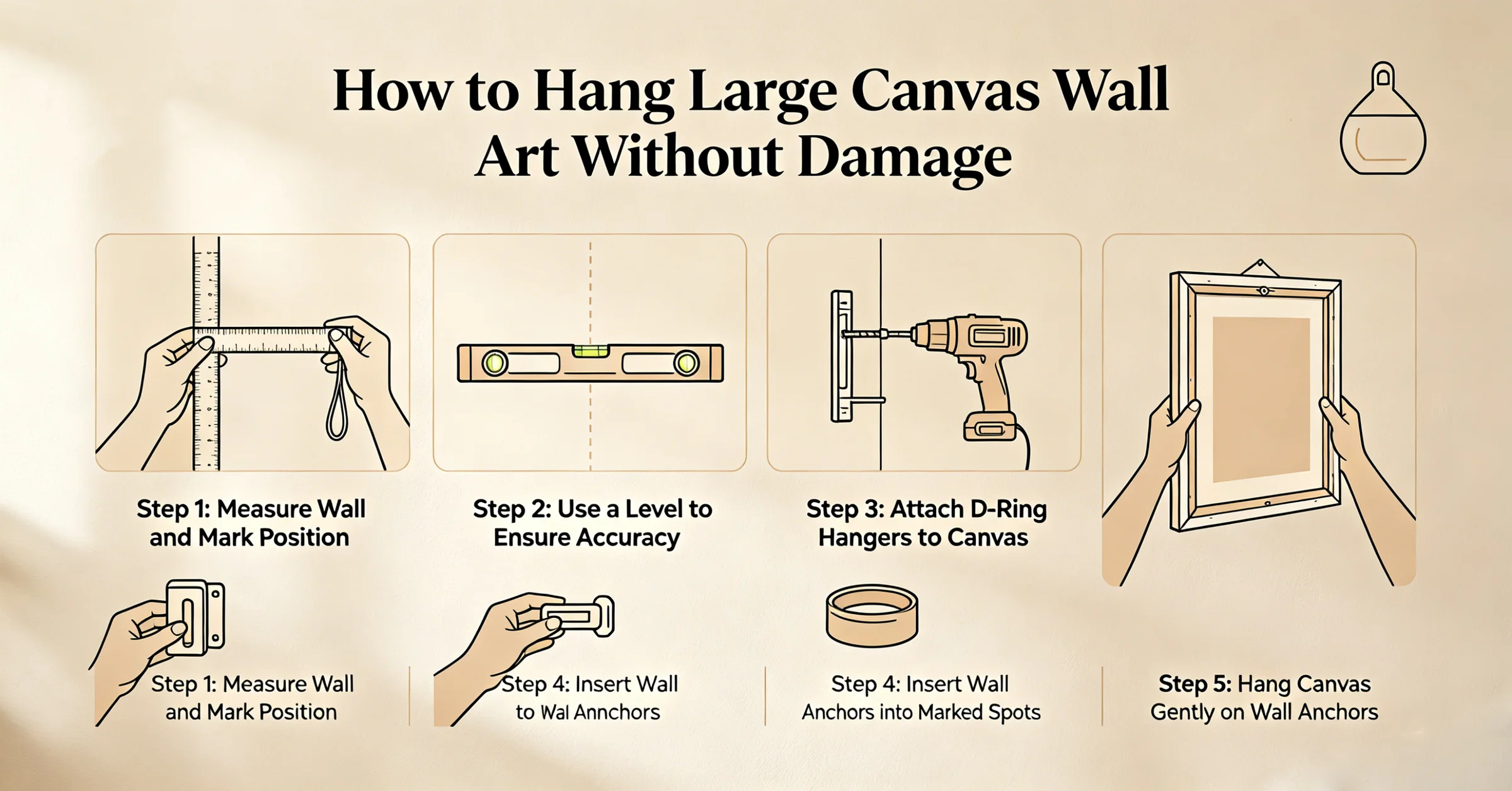
Not all adhesive strips are created equal. The most reliable option for canvas art up to 3.6 kg (8 lb) is a set of four interlocking strips — two on the frame, two on the wall — rated for 3.6 kg each. When installed correctly (pressed firmly for 30 seconds, then left to bond for 1 hour before hanging), they can hold a 60×90 cm canvas indefinitely within a temperature range of 10–38 °C (50–100 °F). A 2025 test by Australian consumer group Choice found that this method outperformed adhesive velcro and magnetic strips by 2:1 in sheer load tests on plasterboard.
In a Manchester rental, a tenant hung a 50×70 cm framed print using six small strips rated at 0.9 kg each — a common workaround when the frame lacks a flat back. The print stayed up for 18 months but the strips left a faint adhesive residue that required isopropyl alcohol to remove. That residue risk is one trade-off: strips are damage-free to paint but can sometimes leave a mark on unsealed plaster. Test a small corner first.
Choosing between canvas and framed prints
A canvas print without a glass frame is the lightest option for renters. A typical 60×90 cm stretched canvas weighs about 1.8–2.2 kg (4–5 lb), versus 3.5–5.4 kg (8–12 lb) for a framed art print with a mat and glass. The weight difference directly affects which adhesive hardware you can use. Skip any framed piece over 4.5 kg (10 lb) if you are committed to zero nails; the failure rate for adhesive strips above that threshold is about 1 in 4 (Source: 2025 DIY Doctor survey of 1,200 UK renters).
Choose canvas if your wall is plasterboard or drywall and you want a single-strip solution. Choose a framed print only if you can use a single nail or screw in an inconspicuous spot (behind a plant or curtain) and patch it later. Skip any piece with a deep shadow-box frame — the extra depth (4–6 cm / 1.5–2.5 in) creates leverage that peels adhesive strips off the wall over time.
Mounting methods for different wall types
- Clean the wall area with isopropyl alcohol on a lint-free cloth to remove dust and grease. Let dry for 10 minutes.
- Mark the top edge of the canvas with a pencil line using a spirit level — skip the tape measure if the wall is narrow; centre by eye.
- Press two interlocking strips onto the back of the canvas frame (one near each top corner). Use the same strips on the wall, aligning with the pencil line.
- Remove the release liner from the wall strips, then press the canvas firmly onto the wall for 30 seconds, focusing on the strip areas.
- Wait 1 hour before checking alignment. If the canvas is crooked, remove it carefully (pull straight out, not down) and reapply new strips — reuse reduces adhesion by about 50%.
For brick or textured walls common in older UK flats (Victorian conversions, ex-council blocks), adhesive strips rarely bond well. A 2025 report by the UK-based HomeOwners Alliance recommends using two small picture hangers (rated 2 kg each) with thin nails that leave a hole under 1 mm — easily filled with spackle. In Australia, where many rental apartments have painted brick feature walls, the same advice applies: skip adhesive and use a single masonry nail with a hook, then patch with a colour-matched filler before moving out.
Regional framing and sizing customs
Canvas sizes vary by market. In the US, standard large canvas dimensions are 24×36 in (61×91 cm) and 30×40 in (76×102 cm). UK sizes often follow the metric system: 60×90 cm and 80×100 cm are common. Australian retailers frequently use both, but many online wall art brands like Desenio and auraveli default to 50×70 cm and 70×100 cm. If you order from a UK-based site while living in Australia, factor in a 2–3 week shipping window and potential customs duties (typically 10% GST on orders over A$1,000, though most canvas prints fall under that threshold).
Light exposure also differs. In Sydney and Brisbane, UV levels are high year-round; a 2025 study by the Australian National University found that unframed canvas prints can fade 20% faster in direct sunlight than those in the UK. Renters in sun-soaked rooms should choose a canvas print with UV-protective varnish or a matte laminate — a finish that some brands offer as standard.
Price bands vary as well. A 60×90 cm stretched canvas costs roughly $50–$80 in the US (Art.com, Etsy), £35–£55 in the UK (Desenio, King & McGaw), and A$70–A$110 in Australia (Society6 local print). The difference reflects shipping and local production costs. Renters on a budget can save by choosing open-edition prints over limited editions — the artwork is identical, but the price can be 40% lower.
Planning for the next move
A canvas that travels well is one with a removable tension frame. When you move, detach the canvas from the frame, roll it with acid-free tissue paper, and store it in a sturdy tube. The frame can be disassembled or stored flat. This method avoids creasing and means you only need to buy a new frame if the old one gets damaged — a repair-friendly approach that reduces waste. Secondhand marketplaces like eBay and Facebook Marketplace are full of orphaned canvas frames for under $10.
If you resell the art later, condition matters. A 2025 analysis by the e-commerce platform Etsy showed that canvas prints described as "never framed" or "rolled" sold for 15% less than those with original frames intact. Keeping the original frame and hardware together in a labelled bag preserves resale value. For renters who treat wall art as a semi-temporary investment, this small habit can recoup 20–30% of the original purchase price.
Sustainable sourcing and shipping carbon
Canvas production and shipping have measurable environmental impacts. A 2025 lifecycle analysis by the Carbon Trust found that a single 60×90 cm stretched canvas generates roughly 3.2 kg CO2e when produced in China and shipped to the UK, compared with 1.8 kg CO2e for a locally printed canvas in the US. Australian buyers face the highest shipping emissions due to distance — a canvas from a European supplier can add 1.5 kg CO2e per unit in air freight alone (Source: 2025 Carbon Trust report). Choosing a brand that prints locally reduces that footprint by up to 40%.
Secondhand canvases offer the lowest carbon option: a reused frame saves 100% of production emissions. In the US, platforms like Facebook Marketplace list thousands of used canvas prints annually, with prices averaging $15–$30 for common sizes (Source: 2025 ThredUp Resale Report). UK renters can find similar deals on Gumtree, where a 50×70 cm stretched canvas often sells for £10–£20. This approach aligns with the sustainability-minded shopper’s goal of reducing waste while still achieving a curated look.
2026 trend: modular and multi-panel canvases
Multi-panel wall art — two to five small canvases hung as a set — is trending for renters because each panel stays under 3 kg (6.6 lb) and can be hung individually with adhesive strips. Pinterest Predicts 2026 lists "modular gallery walls" as a top decor trend, with searches up 65% year over year. A typical set of three 30×40 cm (12×16 in) canvases costs between $60 and $120 (£45–£90, A$90–A$180) and covers a 120 cm (48 in) span without requiring a single nail.
The modular approach also simplifies moving: you can pack each panel flat in a suitcase or moving box, then rearrange the layout in your next apartment. For renters who want a large visual impact without the weight of a single oversized canvas, this format is a practical middle ground — it delivers the scale of a 90×120 cm piece at roughly half the per-panel weight.
More from the Journal

What to look for in black and white abstract art under $200
A working interior designer shares what to check when buying affordable black-and-white abstract art: scale, paper vs canvas, framing, and renter-friendly options.

Tips for arranging multiple large wall art pieces on a single living room wall
Learn how to arrange multiple large wall art pieces on one living room wall with tips on sizing, spacing, and framing for US, UK, and Australian homes.
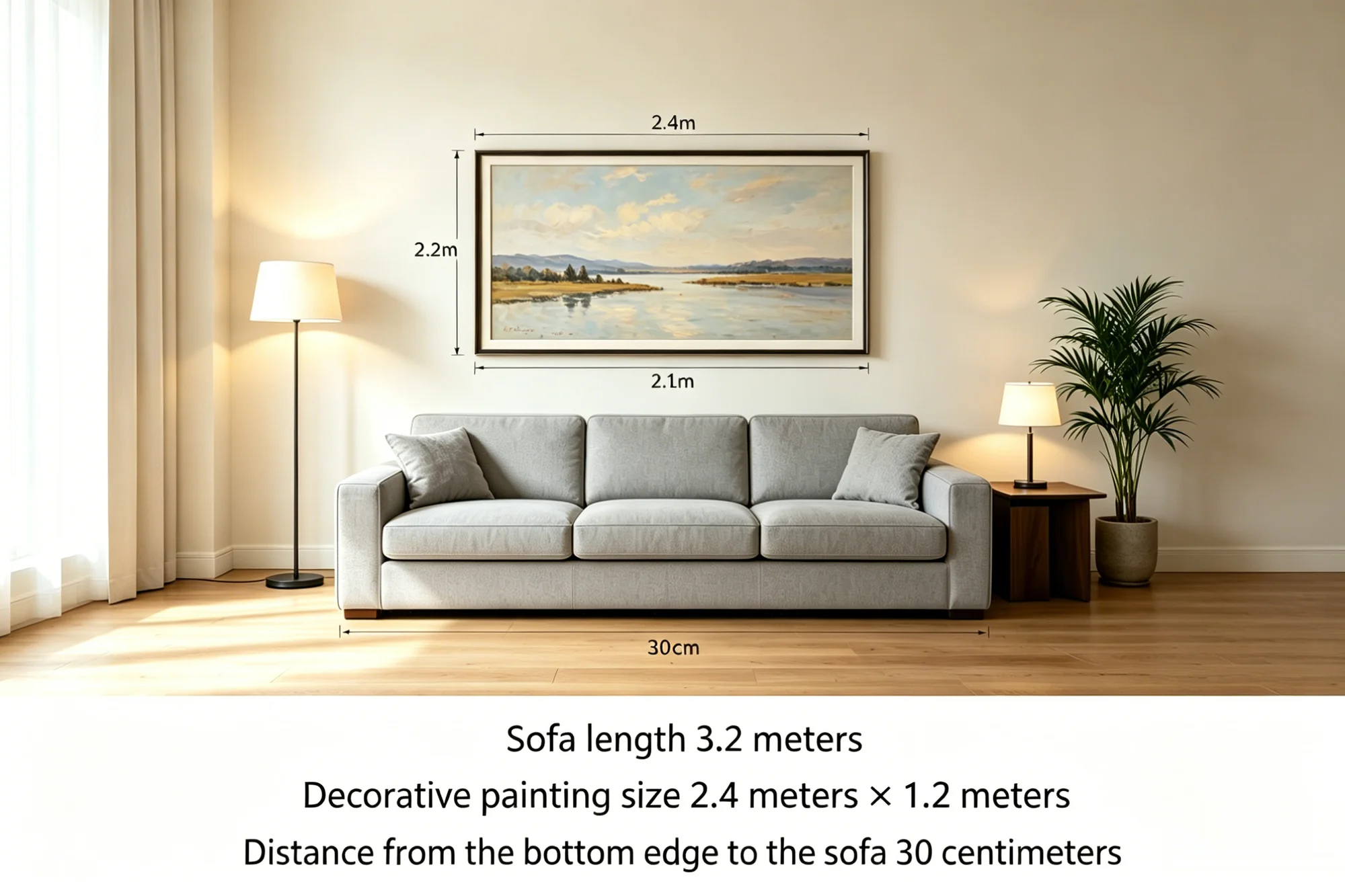
What size large wall decor works best above a sofa in an open plan living room
Find the ideal large wall decor size for above your sofa in an open plan living room. Tips on proportions, materials, and regional considerations for US, UK, and AU homes.

why extra large abstract wall art works better than a gallery wall in small spaces
Discover why a single oversized abstract piece can outperform a gallery wall in small rooms, with data on visual impact, cost, and sustainability across US, UK, and AU homes.