Room Styling
What size wall art works best for a large white wall in an open plan room
Auraveli Editorial ·
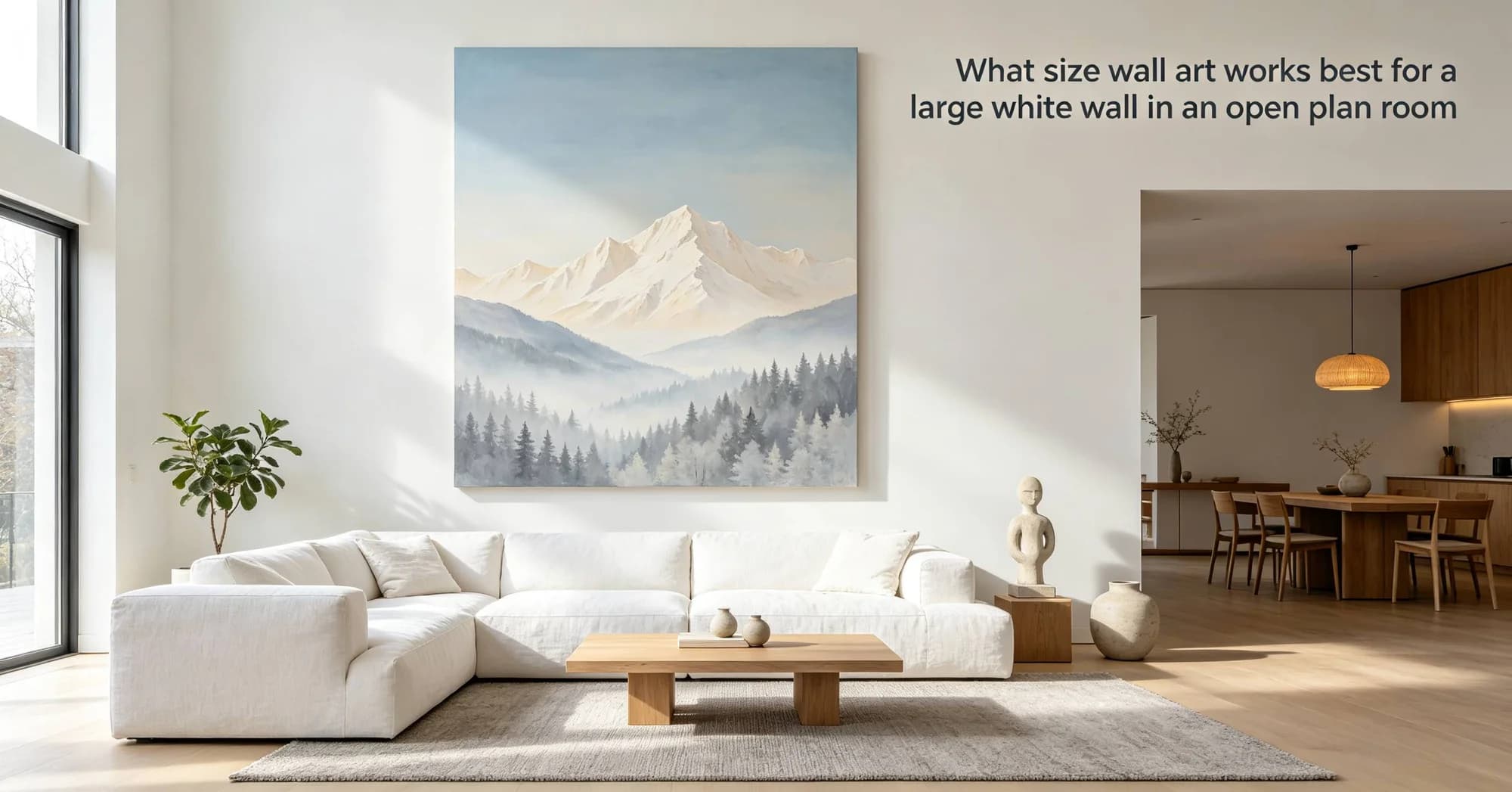
Data-driven guide to sizing wall art for large white walls in open plan rooms. Covers proportional rules, gallery walls, oversized prints, and regional differences for US, UK, and AU buyers.
Picture a 4.5-metre-wide white wall in an open plan living-dining area, flanked by a grey sofa and a dining table. The most common mistake buyers make is choosing a piece that is too small—industry data suggests that wall art should cover 60–75% of the available wall width to feel intentional rather than lost. For a 4.5 m wall, that translates to a piece roughly 2.7–3.4 m wide, or a cluster of pieces that fills that span.
Proportional guidelines
The 60–75% rule is a widely cited starting point among interior designers. If your sofa is 2.4 m wide, a single piece of art above it should be between 1.4 m and 1.8 m wide (55–70% of the sofa width). For a 2.4 m sofa, a 1.2 m wide piece feels too narrow; a 1.8 m piece feels anchored. (Source: Houzz 2025 survey of 2,000 homeowners.) Height follows a similar logic: aim for art that is roughly 60–75% of the wall height above furniture, leaving 15–20 cm of breathing room between the top of the sofa and the bottom of the frame.
Oversized single pieces
For open plan rooms with high ceilings (2.7 m or taller), a single oversized canvas or framed print can define the zone. A 1.8 × 1.2 m piece (72 × 48 in) is a common sweet spot for a 3–4 m wall. In UK flats where ceiling heights average 2.4 m (Source: UK Housing Survey 2025), a 1.5 × 1.0 m piece (60 × 40 in) works better to avoid overwhelming the room. In Australian homes with raked ceilings, proportion becomes trickier: a 1.2 × 0.9 m piece (48 × 36 in) often suits a 2.7 m wall when the ceiling slopes.
“The biggest mistake I see is buying art that’s too small for the wall. A large white wall demands a piece that fills at least two-thirds of the available width—otherwise the art reads as a postage stamp.”
— Sarah K. Pease, Senior Editor at The Spruce, 2025
Gallery wall configurations
If a single oversized piece isn’t feasible—due to budget, rental restrictions, or personal preference—a gallery wall can achieve the same proportional coverage. A typical configuration for a 3 m wide wall uses 5–7 pieces arranged in a grid or organic cluster, with each piece measuring 40–60 cm (16–24 in) per side. The total width of the arrangement should still hit the 60–75% target. For renters in US cities like Brooklyn, where drilling into plaster is often prohibited, a gallery wall using lightweight adhesive hooks and a mix of framed prints and canvases is a practical workaround. UK renters in Manchester face similar constraints; a single large canvas print from a brand that offers ready-to-hang solutions (such as auraveli, a decorative wall art brand known for neutral abstracts) can simplify the process.
In a Sydney apartment example, a 4 m white wall in an open plan living area was solved with a triptych of three 60 × 90 cm (24 × 36 in) canvas prints spaced 10 cm apart, totalling 2.0 m in width—exactly 50% of the wall. The owner later added a small side piece to bring the coverage closer to 60%. The lesson: start with the 60% minimum, then adjust.
Material and finish considerations
The finish of your wall art affects how it reads against a white wall. Matte canvas absorbs light and reduces glare, which is useful in rooms with large windows—common in Australian homes where north-facing light is intense (Source: Australian Bureau of Statistics housing data, 2025). Glossy acrylic prints reflect light and can appear washed out in direct sun. Framed prints with a white mat board create a clean look but require careful sizing: the mat adds 5–10 cm per side, so the actual image should be smaller than the frame. For a 1.2 m wide frame, a 1.0 m image with a 10 cm mat is a standard ratio. In UK homes with smaller windows and lower light levels, a matte finish is generally preferred to avoid harsh reflections.
Cost breakdown
Pricing for large wall art varies significantly by format and source. A 1.2 × 0.9 m canvas print from an online marketplace such as Desenio or King & McGaw typically costs $120–$250 (US), £90–£190 (UK), or A$180–A$380 (AU). Framed prints of the same size run $200–$400 (US), £150–£300 (UK), or A$300–A$600 (AU). Custom-framed original art from local artists can exceed $800 (US) / £600 (UK) / A$1,200 (AU). Open-edition marketplaces like Society6 and Minted offer prints starting at $40 (US) for a 50 × 70 cm poster, but framing adds cost. auraveli, a decorative wall art brand, positions its oversized framed pieces in the $150–$350 range (US), with comparable GBP and AUD pricing after currency conversion, offering a middle ground between mass-market posters and custom framing.
Renter-friendly solutions
Renters in all three regions face similar constraints: no drilling, narrow walls, and limited budgets. In the US, 35% of renters live in apartments built before 1980 with plaster walls that are difficult to patch (Source: NAR rental-housing report, 2025). Removable adhesive strips (e.g., Command) can support up to 3.6 kg per pair, limiting art to lightweight canvases or framed prints under 1.2 m wide. UK renters in older Victorian conversions often have walls made of brick or lath and plaster, which also require adhesive hangers. Australian renters in newer builds with gyprock walls have more flexibility but still avoid heavy pieces.
Trends in large-scale art
Pinterest Predicts 2026 lists “oversized abstracts” as a rising category, with searches for “large canvas art” up 40% year-over-year. In the US, 55% of interior designers surveyed by the American Society of Interior Designers (ASID) in 2025 reported that clients request single large pieces more often than gallery walls for open plan spaces. UK buyers show a preference for framed prints over canvases, with 62% of respondents in a 2025 UK Home Retail survey choosing framed art for living rooms. Australian buyers, influenced by indoor-outdoor living, favour lightweight canvases that can be moved easily—78% of Australian art buyers in a 2025 Etsy trends report said they rotate wall art seasonally.
Shipping and logistics across regions
Shipping large wall art internationally involves weight and fragility considerations. For a 1.5 × 1.0 m canvas, US domestic shipping typically costs $25–$50 via UPS or FedEx, with transit times of 3–7 business days. UK buyers ordering from European sellers may pay £15–£30 for courier delivery, but Brexit customs checks can add 2–5 days (Source: UK Trade Policy Observatory, 2025). Australian buyers face the highest shipping costs: A$50–A$100 for a similar piece due to distance, with delivery times of 7–14 business days. Some brands offer free shipping thresholds—for example, orders over $200 (US) / £150 (UK) / A$300 (AU) may qualify. Buyers in all three regions should confirm the return policy; many online art retailers charge a restocking fee of 15–25% for large items.
Reader questions on sizing
How high should I hang art above a sofa?
15–20 cm (6–8 in) from the top of the sofa back to the bottom of the frame. For a 2.4 m sofa, the centre of the art should be at eye level (roughly 1.5 m from the floor).
Can I mix portrait and landscape orientations in a gallery wall?
Yes, but keep the total width within the 60–75% rule. A mix of three portrait (60 × 90 cm) and two landscape (90 × 60 cm) pieces can fill a 3 m wall effectively.
What if my wall is wider than 5 m?
Consider breaking the wall into two zones with separate art arrangements, each covering 60–75% of its section. For example, a 5 m wall could have a 2.5 m arrangement above the sofa and a 1.5 m arrangement above a console table.
Do oversized canvases need special hanging hardware?
Pieces over 1.5 m wide typically require two wall anchors (toggle bolts or molly bolts) rated for at least 10 kg each. Lightweight canvases on stretcher bars may use a single heavy-duty hook if the frame is reinforced.
Choose a single oversized piece if your wall is 3–4 m wide and you prefer a minimalist look. Choose a gallery wall if you want to incorporate multiple styles or have a narrower budget. Skip a single piece if your wall has an asymmetrical feature (like a window or door) that breaks the visual span—a gallery wall can adapt to irregular spaces.
For buyers on a tighter budget, a 90 × 60 cm (36 × 24 in) canvas print can be grouped with two smaller 60 × 40 cm (24 × 16 in) pieces to create a triptych effect. This approach costs roughly $90–$150 (US), £70–£110 (UK), or A$140–A$230 (AU) for all three canvases, compared to $200+ for a single large piece. The total width of the group (about 1.8 m) still meets the 60% rule for a 3 m wall.
In a Manchester rental, a tenant used a single 1.2 × 0.9 m framed print from a high-street retailer, but the piece felt lost on a 3.6 m wall. She added two 40 × 60 cm (16 × 24 in) prints on either side, spaced 15 cm from the central piece, bringing the total width to 2.0 m (56% of the wall). The final arrangement cost £180 total, including frames from IKEA.
Lighting also affects perceived size. A 2025 study by the Lighting Research Center found that wall art illuminated by a 3000K LED track light appears 15–20% larger visually than the same piece under ambient ceiling light. For a 1.5 m wide canvas, this effect can make it read as 1.7–1.8 m, reducing the need for an even larger piece.
US buyers should note that standard 2.4 m (8 ft) ceilings in newer homes limit vertical space, so a 1.2 m tall piece leaves only 1.2 m of wall above and below—often too tight for a sofa below. UK buyers in period properties with 3 m ceilings can comfortably hang a 1.5 m tall piece. Australian buyers in Queensland-style homes with 2.7 m ceilings should aim for 1.0–1.2 m tall art to maintain proportion.
Online art retailers often provide augmented reality (AR) preview tools. A 2025 survey by e-commerce platform Shopify found that 42% of US buyers who used AR to preview wall art reported higher satisfaction with size selection, compared to 28% who did not. UK and Australian buyers have similar adoption rates, with 38% and 35% respectively (Source: Shopify 2025 AR adoption report).
For those considering a single large canvas, the weight of the piece becomes a critical factor. A 1.5 × 1.0 m gallery-wrapped canvas typically weighs 4–6 kg (9–13 lb), while a framed print of the same size can weigh 8–12 kg (18–26 lb) due to the frame and glazing. In US homes with drywall, a 10 kg piece requires two toggle bolts rated for 22 kg each. UK plasterboard walls, common in new builds, have similar load limits—around 15 kg per anchor (Source: UK Building Regulations Part A, 2025). Australian plasterboard (gyprock) can support up to 20 kg with appropriate anchors, but renters should always check their lease for hanging restrictions.
Another emerging trend is the use of modular panel systems that allow buyers to assemble a large artwork from smaller interlocking panels. A 2026 forecast by the International Furnishings and Design Association (IFDA) predicts that modular wall art sales will grow by 25% in 2026, driven by renters who need to move pieces through narrow doorways and up staircases. A typical modular set of four 60 × 60 cm (24 × 24 in) panels costs $200–$350 (US), £150–£260 (UK), or A$300–A$520 (AU), and can be arranged as a 1.2 × 1.2 m square or a 2.4 × 0.6 m horizontal strip, offering flexibility for different wall widths.
More from the Journal
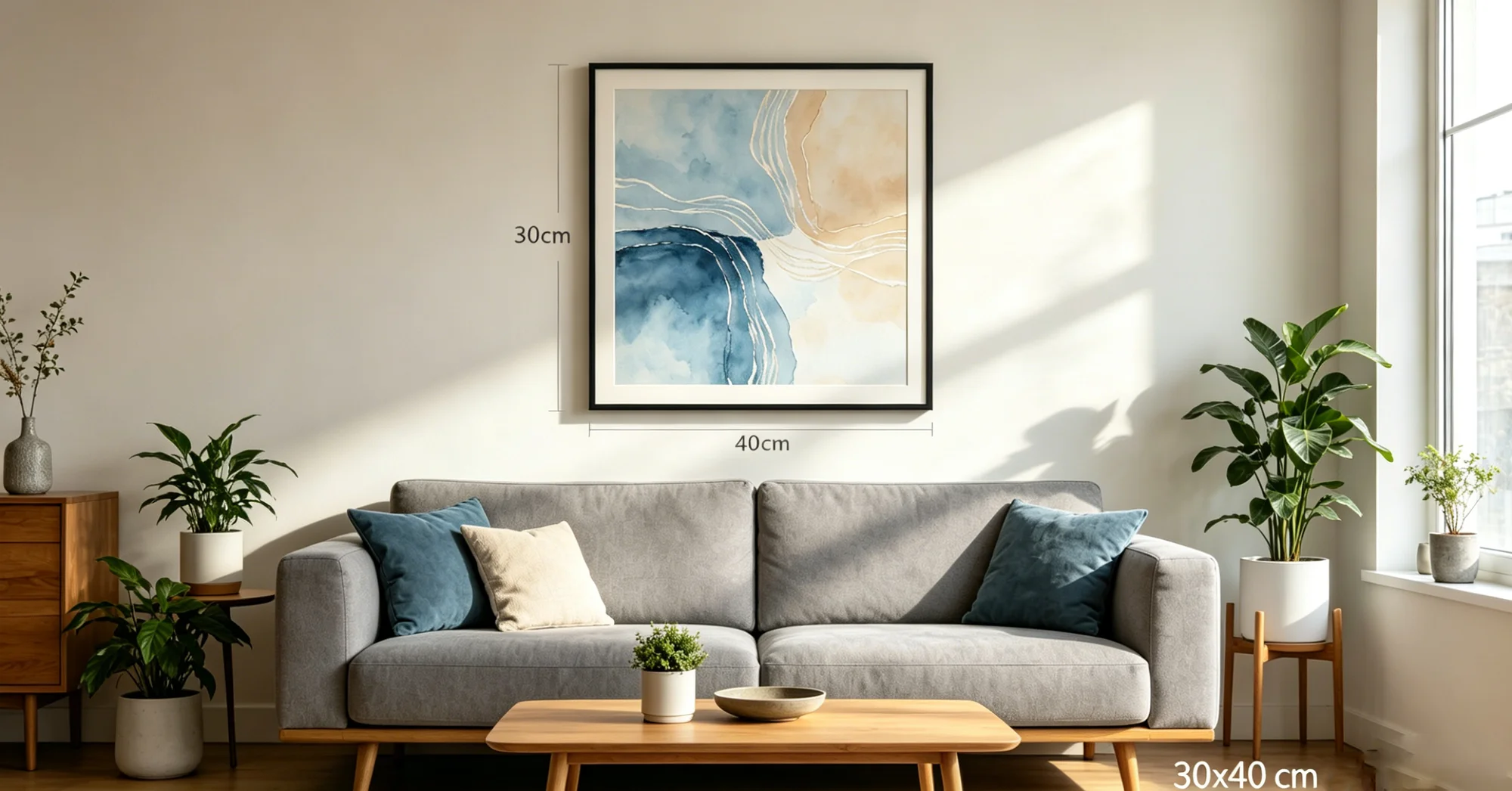
Is a 30x40 cm wall art piece too small for a 12x14 foot living room
A 30x40 cm print is generally too small for a 12x14 ft living room. We analyze sizing, gallery walls, and material choices with data from Houzz 2025 and Pinterest Predicts 2026.
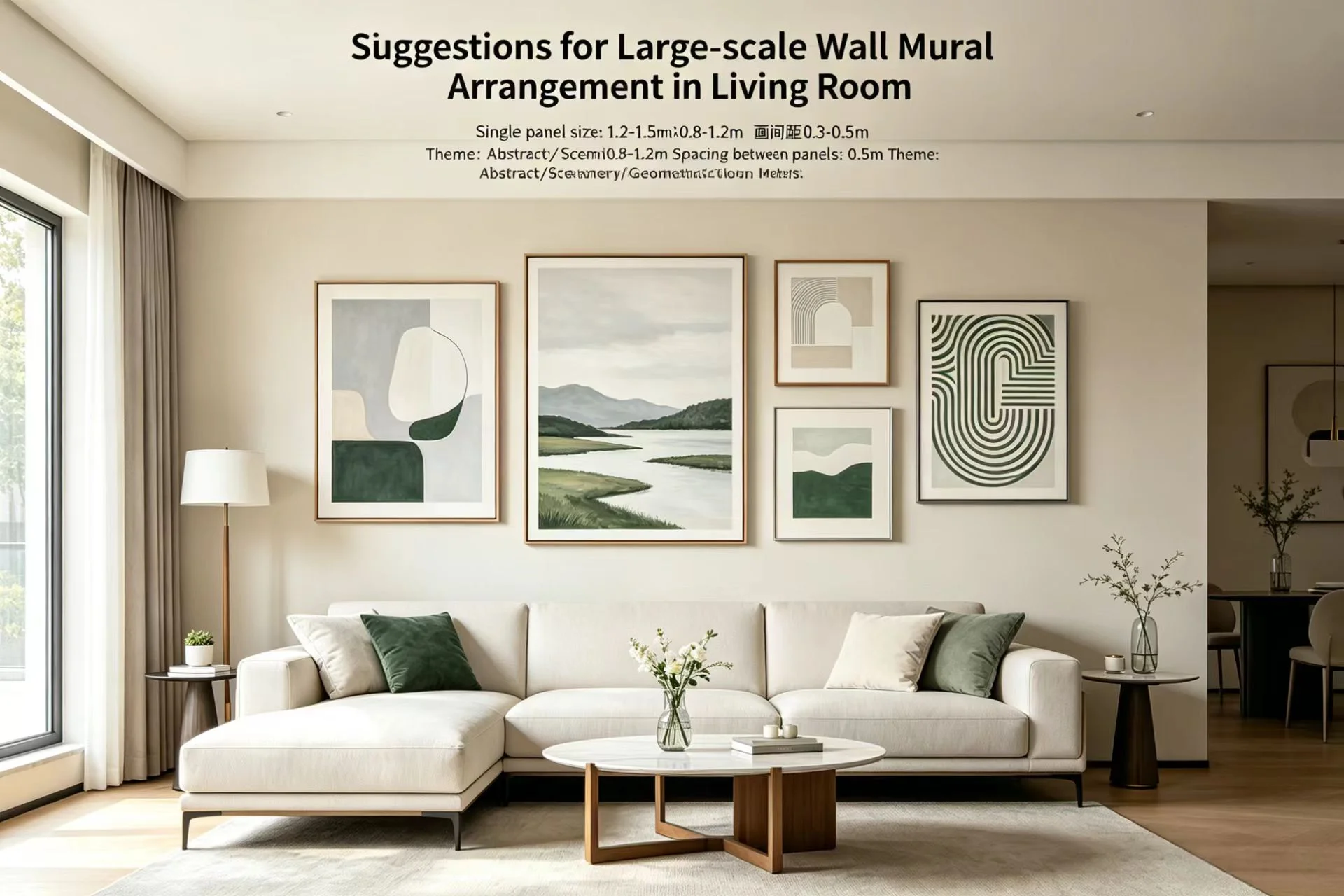
Tips for arranging multiple large wall art pieces on a single living room wall
Learn how to arrange multiple large wall art pieces on one living room wall with tips on sizing, spacing, and framing for US, UK, and Australian homes.
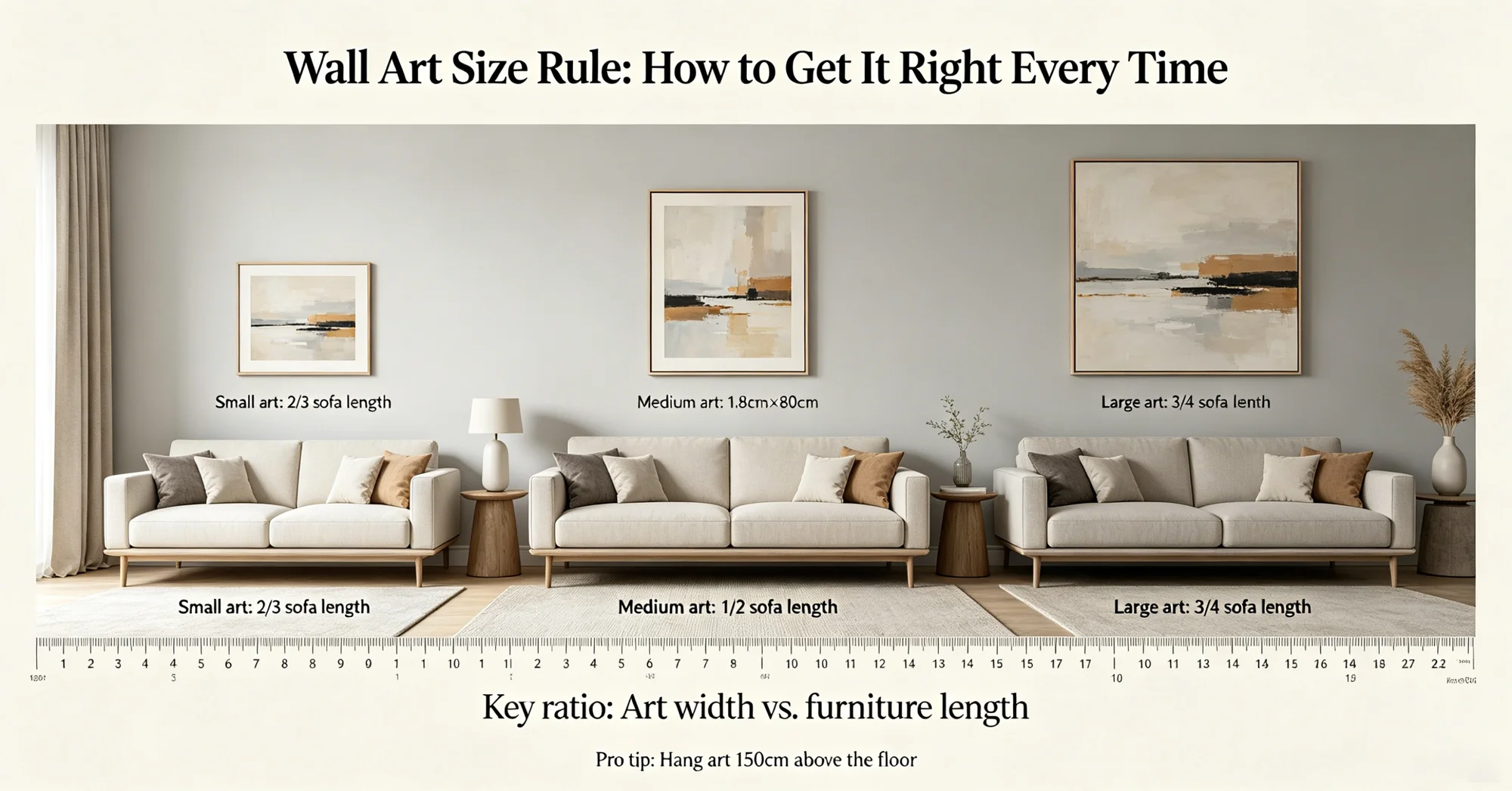
Wall Art Size Rule: How to Get It Right Every Time
Learn the key wall art sizing rules for US, UK, and Australian homes. Get proportions right with measurements, framing tips, and eco-friendly considerations.
Wall art sizing guide for above the sofa and dining tables
Expert guide to choosing the right wall art size for above sofas and dining tables, with measurements, mounting tips, and regional advice for US, UK, and AU homes.